
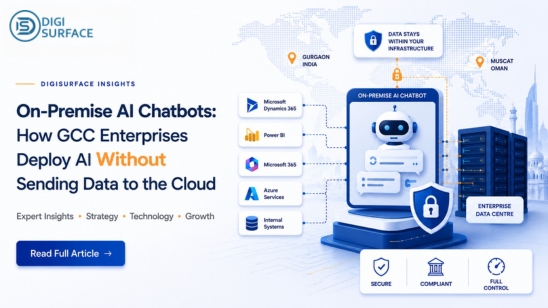
The real blocker holding back AI adoption across the GCC usually isn’t budget, and it isn’t model quality either. It’s a simpler, unresolved question: the moment an employee types or speaks a query into an AI assistant, where does that data actually go? For enterprises handling regulated data, payroll records, customer information, internal compliance queries that question doesn’t have a comfortable answer with most cloud AI tools. An on-premise AI chatbot answers it by design, not as an afterthought, keeping every query inside the organization’s own infrastructure rather than routing it through a third-party server somewhere else in the world.
What an On-Premise AI Chatbot Actually Is
An on-premise AI chatbot processes and stores conversation data entirely within an organization’s own infrastructure, rather than routing queries through a third-party cloud provider’s servers. This is distinct from a self-hosted LLM for enterprise deployment more broadly the LLM is the underlying model doing the reasoning, while the chatbot is the interface employees or customers actually interact with. You can self-host the model and still expose it through a poorly architected chatbot that leaks data elsewhere; a properly built on-premise chatbot keeps the entire chain, from query to response, inside the organization’s perimeter.
Why Cloud Chatbots Create a Compliance Problem in the GCC
Here’s where most enterprises get caught off guard: selecting a Gulf-region setting in a cloud AI dashboard does not automatically satisfy local data processing law. Even “region-selected” cloud chatbots can still log, cache, or process data outside the country during model inference, creating direct exposure under data residency GCC regulations. In Oman specifically, the Communications and Information Technology Regulatory Authority (CITA) oversees telecom and data-related compliance, and enterprises deploying AI tools that touch regulated data need their architecture not just their vendor’s marketing page to satisfy those requirements. This is the gap an on-premise deployment closes structurally, rather than relying on a settings toggle to do it for you.
Where This Shows Up: HR and IT Helpdesk Voice Queries
This isn’t an abstract compliance concern; it shows up in some of the most common internal AI use cases enterprises are already deploying. An employee asking an AI assistant a payroll-related question, something touching GOSI-linked salary, benefits, or deduction data is a genuinely sensitive query, even though it feels routine to the person asking it. The same applies to IT helpdesk voice queries, where an employee might speak a question aloud rather than type it. If that voice query gets routed through an external speech-to-text API before the AI model ever processes it, sensitive employee data has already left the organization’s infrastructure before the “AI” part even happens. This is exactly the gap a hybrid voice chatbot is built to close keeping voice processing local for sensitive HR and payroll and IT queries, while still giving employees a natural, spoken interface instead of forcing everything through a text box.
On-Premise vs Cloud vs Hybrid Voice Chatbot: What Changes
Laid out side by side, the practical differences in where data actually travels become clear:
| Cloud Chatbot | On-Premise AI Chatbot | Hybrid Voice Chatbot | |
| Where data is processed | Third-party servers, often outside the country | Entirely within the organization’s infrastructure | Sensitive queries on-premise, general queries to cloud |
| Voice query handling | Often routed through external speech-to-text APIs | Speech processing kept in-house | Voice processed locally, non-sensitive follow-ups may route to cloud |
| Compliance fit for CITA-region rules | Weakest | Strongest | Case-by-case, depends on data classification |
| Best for | Low-sensitivity, general queries | HR, payroll, and other regulated internal data | Enterprises transitioning from cloud to full on-premise |
| Setup complexity | Lowest | Highest | Moderate |
The Regulatory Backdrop: CITA and the Wider GCC Picture
Oman’s CITA doesn’t operate in isolation it sits within a broader regional shift toward stricter data processing rules that any enterprise deploying an on-premise AI for GCC operations needs to track:
| Country | Regulator | What It Means for AI Chatbot Deployment |
| Oman | CITA / MTCIT | Telecom and data compliance oversight; PDPL Executive Regulations fully in force since Feb 2026 |
| Saudi Arabia | SDAIA | PDPL enforcement with strong data localization expectations |
| UAE | UAE Data Office / DIFC / ADGM | Federal Decree-Law 45/2021, with 2026 Executive Regulations clarifying cross-border data flows |
| Qatar | NCSA | Law No. 13/2016, less prescriptive on cross-border AI processing than neighbors |
| Bahrain | DPA | Strictest enforcement regime, including criminal penalties for violations |
What to Check Before Deploying an On-Premise AI Chatbot
Before committing to a full on-premise build, it’s worth working through a short checklist most enterprises skip in their rush to deploy something quickly:
- Classify your queries first– separate genuinely sensitive queries (payroll, HR, customer financial data) from general ones (IT password resets, office FAQs), since not everything needs the same level of protection
- Confirm where voice processing actually happens– a chatbot can be “on-premise” for text while still routing voice through an external speech API; ask specifically about the full pipeline, not just the model
- Check your specific regulator’s requirements– CITA’s expectations for Oman-based operations differ from SDAIA’s for Saudi Arabia, so a single generic compliance answer usually isn’t accurate
- Consider a phased hybrid rollout– moving straight to a full on-premise deployment isn’t always necessary; a hybrid AI chatbot can reduce exposure immediately while a longer-term architecture is built out
How DigiSurface Deploys On-Premise and Hybrid AI Chatbots
Getting this architecture right takes more than picking a vendor with an “on-premise” checkbox in their pricing page. DigiSurface’s AI solutions for enterprise clients across the GCC are built around exactly the questions raised above:
- On-premise AI chatbot architecture – deployed so conversation data, documents, and model outputs stay within your own infrastructure by design
- Hybrid voice chatbot deployment for HR and IT helpdesk use cases where voice queries need to stay local without forcing a full on-premise rebuild on day one
- CITA-aligned compliance mapping – assessing which of your current AI workloads actually meet Oman’s data processing requirements, and which don’t
- Query classification support -helping teams separate sensitive HR/payroll queries from general ones before deployment, so the architecture matches the actual risk
This isn’t about pushing every enterprise toward the most complex build available, it’s about matching the deployment to what your data actually requires.
Frequently Asked Questions
What is an on-premise AI chatbot?
An on-premise AI chatbot is an AI assistant deployed on infrastructure an organization controls directly, meaning conversation data, documents, and model outputs are processed and stored entirely within the organization’s own environment rather than on a third-party cloud provider’s servers. This is particularly relevant for enterprises handling regulated data, such as HR, payroll, or customer financial information.
Does Oman’s CITA require on-premise AI for enterprises?
CITA doesn’t mandate on-premise AI outright, but it does oversee telecom and data processing compliance in Oman, and enterprises handling regulated data need their AI deployment to satisfy those requirements. For many regulated use cases, an on-premise or hybrid architecture is the more reliable way to meet that compliance bar than a cloud-only deployment.
What is a hybrid voice chatbot?
A hybrid voice chatbot processes sensitive voice queries locally, on-premise, while routing general, non-sensitive follow-up questions to a cloud-based model. This approach lets enterprises offer a natural, spoken interface for employees or customers without exposing sensitive data through external speech-to-text or cloud AI processing.
Can an on-premise AI chatbot handle voice queries in Arabic and English?
Yes, on-premise AI chatbots can be configured to handle voice queries in multiple languages, including Arabic and English, with the speech processing itself kept local rather than routed through an external, cloud-based language API.
Deploy AI Without Sending Your Data Somewhere Else
If your enterprise is fielding HR, payroll, or IT helpdesk queries spoken or typed that touch regulated employee or customer data, the deployment architecture matters as much as the AI model itself. Book a consultation with DigiSurface to map an on-premise or hybrid voice chatbot deployment that actually fits your compliance requirements, instead of assuming a cloud tool’s region setting has you covered.
Facing AI deployment or data privacy challenges?
If your enterprise is already exploring AI or you are unsure whether your current AI setup meets your data, security, and compliance requirements we can help.
Let DigiSurface assess your use case and design an on-premise or hybrid AI solution built around your enterprise’s specific needs. – Book Free 10-Hour Consultation