
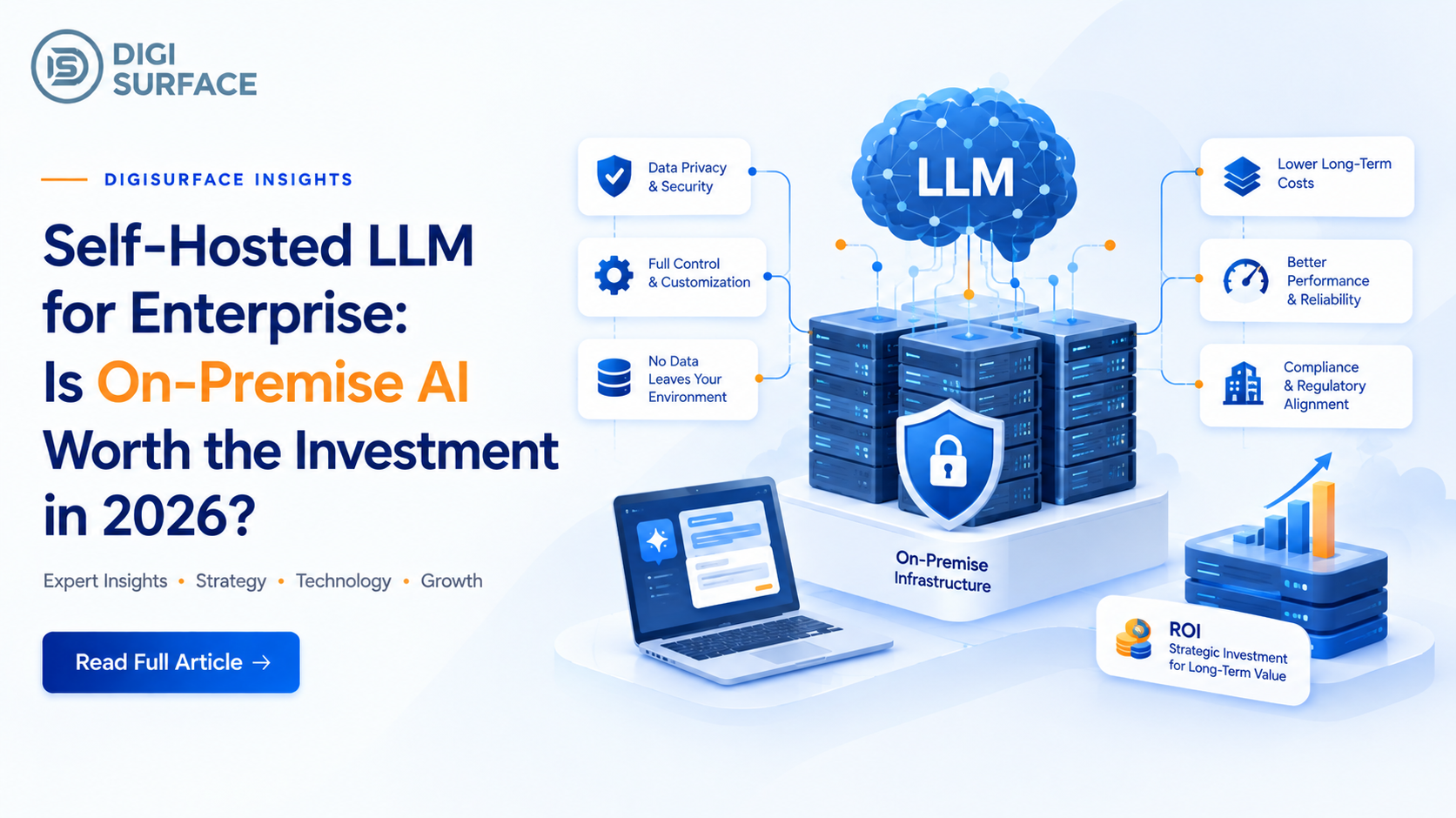
Quick Answer: Is a Self-Hosted LLM Worth It for Your Enterprise in 2026?
- Query volume decides it — cloud AI cost scales per token indefinitely; a self-hosted LLM costs more upfront but flattens close to free at scale.
- Data sensitivity outweighs pure cost math — for regulated data (banking, healthcare, government), a compliance violation or client walking away after a data incident is a cost a hardware-vs-cloud comparison never captures.
- Time-to-value is the real trade-off — cloud AI can be running in minutes; a self-hosted deployment takes longer to plan, provision, and validate.
- GCC and India regulations are tightening, not loosening — Saudi PDPL, Oman’s Executive Regulations (fully in force since Feb 2026), and India’s DPDP Act all push toward in-country processing for regulated data.
Full ROI framework, cost comparison table, and GCC/India regulatory breakdown below.
Every CTO evaluating enterprise AI right now eventually hits the same fork in the road: keep paying per seat or per token for a cloud model, or invest upfront in a self-hosted LLM for enterprise deployment that lives entirely inside your own infrastructure. Neither answer is automatically right. The decision comes down to how sensitive your data is, how much volume you’re actually running, and how much regulatory exposure you’re carrying three variables that look very different for a 50-person fintech than they do for a regional bank with operations across three countries. This guide walks through what a self-hosted LLM actually is, when the investment pays off, and where it genuinely matters more than a preference starting with data residency.
What “Self-Hosted LLM” Actually Means
A self-hosted LLM is a large language model that runs on infrastructure your organization controls on-premise servers or a private cloud environment rather than on a third-party provider’s servers. Prompts, documents, and outputs never leave your own environment, which is the entire point: nothing gets processed, logged, or stored outside a perimeter you control. This is different from a hybrid AI chatbot approach, where some workloads (general, non-sensitive queries) route to a cloud model while sensitive queries stay on-premise, a middle ground many enterprises use as a stepping stone rather than committing fully to either extreme on day one.
The Real Case for On-Premise AI: Data Residency, Not Just Preference
For regulated industries banking, government, healthcare the case for on-premise AI isn’t really about preference at all. It’s about data residency GCC regulations and similar frameworks that increasingly dictate where data can legally be processed, not just where it’s stored. A cloud AI tool routing prompts through servers outside the country can create real compliance exposure, even when the provider’s “region” setting looks correct on paper. For these sectors, on-premise AI for GCC enterprises has moved from a nice-to-have architecture choice to something closer to a compliance requirement, and the ROI conversation has to include that regulatory risk, not just the infrastructure bill.
The ROI Question: When Does Self-Hosted Actually Pay Off?
This is where most CTOs get stuck, because the honest answer is “it depends” but it depends on three specific, measurable things, not a vague sense of caution.
Query volume. Cloud AI pricing scales with usage, more users, more tokens, more cost, indefinitely. A self-hosted LLM has the opposite cost curve: high upfront investment in hardware, but usage after that point is close to free. At low volume, clouds almost always win. At high volume thousands of daily queries across a large workforce the math flips, sometimes dramatically.
Data sensitivity. Compliance risk has a real cost even when it never shows up as a line item on an invoice. A data residency violation, a regulatory fine, or a client walking away after a data incident are all costs that a pure cloud-vs-hardware cost comparison misses entirely. For regulated data, this factor alone can outweigh the raw infrastructure math.
Time-to-value. Cloud AI is faster to start, often minutes. A self-hosted LLM deployment takes longer to plan, provision, and validate. For an enterprise that needs something running next week, that lead time is a real cost. For one planning a multi-year AI strategy, it’s a rounding error against the long-term savings.
None of these three variables point the same direction for every enterprise, which is exactly why this remains a genuine decision rather than an obvious one.
To make this concrete: a 30-person insurance brokerage running a few hundred internal queries a day, with mostly non-sensitive HR and admin questions, is very likely better served by cloud AI the volume simply doesn’t justify the hardware investment. A regional bank running thousands of daily queries against customer and transaction data, on the other hand, is looking at a very different equation both the volume and the sensitivity of the data push firmly toward self-hosted or hybrid infrastructure. Most enterprises sit somewhere between these two extremes, which is exactly why a generic “on-premise is always better for compliance” or “cloud is always cheaper” answer misses the point. The right call comes from running your own numbers against these three variables, not adopting whichever default your last vendor pitched you.
Self-Hosted vs Cloud vs Hybrid AI Chatbot: Comparing the Options
Laid out side by side, the trade-offs become concrete:
| Cloud AI | Self-Hosted LLM | Hybrid AI Chatbot | |
| Data residency | Tied to provider’s regions | Fully within your infrastructure | Sensitive data on-premise, general queries to cloud |
| Cost model | Scales with usage | High upfront, flat at scale | Mixed, depends on split |
| Setup time | Fastest | Longest | Moderate |
| Best for | Low-volume, non-sensitive use | Regulated, high-volume enterprise use | Enterprises easing into on-premise |
| Compliance fit | Weakest for strict residency rules | Strongest | Case-by-case, needs clear data classification |
Common Objections to On-Premise AI (and What’s Actually True)
CTOs raise the same handful of concerns whenever self-hosted AI comes up. Most are only half true:
- “It’s too expensive”– true if volume is low; the upfront hardware cost only pays off once usage crosses a real threshold, which varies by organization size
- “It’s harder to maintain”– true, but manageable with the right infrastructure partner; this is an operational cost, not a dealbreaker
- “It falls behind on model quality”– increasingly false; open and licensed models have closed much of the gap with proprietary cloud models over the past two years
- “It takes too long to deploy”– varies significantly by scope; a narrow, well-defined use case can go live faster than most CTOs assume, while a broad enterprise-wide rollout genuinely does take longer
What This Looks Like for GCC and India Enterprises Specifically
The regulatory backdrop makes this decision even more concrete for enterprises operating across India and the GCC, where residency requirements differ by country but are all tightening in the same direction:
| Region | What’s Driving the On-Premise Conversation |
| Saudi Arabia | PDPL data localization requirements under SDAIA, tied to Vision 2030 |
| UAE | Federal Decree-Law 45/2021, with Executive Regulations clarifying cross-border data transfer rules |
| Oman | PDPL Executive Regulations, fully in force since Feb 2026, with mandatory DPO appointments |
| India | DPDP Act and Rules, phased rollout through 2026-2027, with cross-border transfer restrictions on specific jurisdictions |
For enterprises operating across more than one of these markets, a self-hosted or hybrid approach avoids having to build a separate AI compliance strategy for every country individually. It also sidesteps a subtler problem: regulations in this region aren’t static. Oman’s Executive Regulations only came fully into force in February 2026, and UAE’s cross-border transfer rules were still being clarified through the same year. An architecture that keeps data inside the country by default is far easier to keep compliant as these frameworks continue to evolve than one that has to be re-audited every time a regulator issues new guidance.
How DigiSurface Supports Enterprises Evaluating On-Premise AI
Working through this decision doesn’t have to be a solo exercise for internal IT teams. DigiSurface’s AI solutions for enterprise clients across India and the GCC include:
- On-premise AI chatbot deployment– architected to keep prompts, documents, and model outputs inside your own infrastructure
- Hybrid deployment planning– for organizations that want to start with a hybrid AI chatbot approach before committing fully to self-hosted infrastructure
- Data residency and compliance mapping– assessing which workloads actually require on-premise processing versus which can safely stay in the cloud
- Infrastructure and cost modeling– a practical breakdown of where the self-hosted investment actually pays off for your specific query volume, not a generic estimate
- Ongoing support and model selection– matching the right LLM to each use case instead of routing every query through the same model
This isn’t about pushing every enterprise toward on-premises by default, it’s about mapping the decision honestly against your actual data and usage patterns before committing either way.
Frequently Asked Questions
What is a self-hosted LLM?
A self-hosted LLM is a large language model deployed on infrastructure an organization controls directly on-premise servers or a private cloud rather than on a third-party provider’s servers. This means prompts, documents, and model outputs are processed and stored entirely within the organization’s own environment, which is particularly relevant for enterprises with strict data residency or compliance requirements.
Is on-premise AI more expensive than cloud AI?
It depends on usage volume. On-premise AI requires a higher upfront investment in hardware and infrastructure, but usage costs after that point are largely flat, unlike cloud AI, which scales with every additional user or query. At low query volumes, cloud AI is typically cheaper; at high volumes, self-hosted infrastructure often becomes the more cost-effective option over time.
Does the GCC require on-premise AI for regulated industries?
Requirements vary by country, but regulated sectors like banking and government increasingly face data residency rules that make on-premise or tightly controlled AI deployment the safer compliance path. Saudi Arabia, the UAE, and Oman all have data protection frameworks that directly affect where AI processing can legally take place for sensitive data.
What is a hybrid AI chatbot?
A hybrid AI chatbot splits workloads between on-premise and cloud infrastructure sensitive queries are processed on-premise, while general, non-sensitive queries route to a cloud-based model. This approach lets enterprises reduce data residency risk without the full upfront investment of a fully self-hosted deployment, often serving as a practical middle step for organizations not yet ready to commit fully to either extreme.
Make the Decision With the Right Data, Not a Default
There’s no universally correct answer to whether a self-hosted LLM is worth it the right choice depends on your actual query volume, data sensitivity, and regulatory footprint, not a generic best practice. What matters is making that call with real numbers and a clear view of your compliance exposure, rather than defaulting to whichever option was easiest to set up first. If your organization is weighing this decision,
Book a consultation with DigiSurface to map out what actually fits your data and infrastructure.