
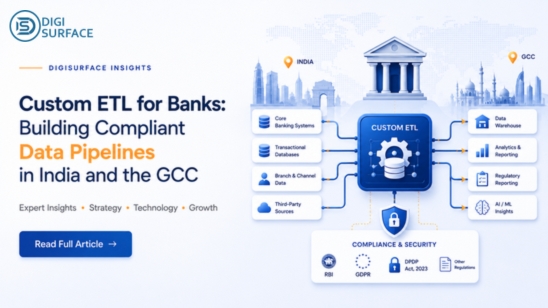
Banks don’t really have a data volume problem. They have a data trust problem. Every pipeline moving customer, transaction, or payment data has to be able to prove, on demand, where that data came from, where it went, and that it never crossed a jurisdiction it wasn’t allowed to. That’s a fundamentally different job than moving data around for a quarterly sales dashboard, and it’s exactly why custom ETL implementation for banks exists as its own category of off-the-shelf ETL tools weren’t built to carry that burden by default.
What Makes Bank ETL Different From Standard ETL
Standard ETL tools exist to move and transform data quickly, usually optimized for reporting speed and ease of setup. Bank ETL has to do all of that while also guaranteeing something most business dashboards never need to prove: full data lineage, jurisdiction-aware processing, and an audit trail a regulator can actually inspect. A retail company’s ETL pipeline failing an audit means an awkward internal meeting. A bank’s ETL pipeline failing one can mean regulatory action, reporting penalties, or a forced pause on operations until the gap is fixed. That difference in stakes is the entire reason banks generally can’t just plug in a generic ETL tool and call it compliant the tool might move the data correctly, but it usually can’t prove it did so in the way a regulator requires.
The Core Compliance Pressures Shaping Bank Data Pipelines Today
In India, the Reserve Bank of India’s 2018 directive on the storage of payment system data requires payment system providers to store the complete end-to-end transaction data only on systems located within India. Foreign processing of the foreign leg of a cross-border transaction is permitted, but that data has to be deleted from overseas systems and brought back into India within 24 hours or one business day, whichever comes first. That’s not a suggestion, it’s a specific, auditable requirement that a bank’s ETL pipeline has to be architected around, not bolted onto afterward.
Across the GCC, the same pressure plays out through different regulators:
- Saudi Arabia– SDAIA enforces strong data localization expectations under its PDPL
- UAE– Federal Decree-Law 45/2021 governs cross-border data transfer mechanics
- Oman– PDPL Executive Regulations, fully in force since February 2026, add in-country processing requirements for regulated sectors, banking chief among them
For a bank operating across more than one of these markets, a pipeline built loosely around “best practices” instead of each regulator’s actual requirements is a compliance gap waiting to surface during an audit and these requirements rarely stay still. Oman’s own Executive Regulations existed on paper for years before enforcement caught up to them, which is exactly why a pipeline architected only to pass today’s audit tends to need a partial rebuild the next time a regulator updates its guidance.
What a Compliant Custom ETL Pipeline Actually Needs
Regardless of which regulator is involved, a handful of requirements show up consistently across every jurisdiction:
- Data lineage tracking– every transformation a piece of data goes through needs to be logged and traceable back to its source, not just the final output
- In-country processing– regulated data shouldn’t cross a border during transformation, not just at rest in storage
- Regulatory reporting formats built in– pipeline output structured for what the specific central bank or regulator actually requires, rather than a generic export that needs manual reformatting
- Role-based access and audit trails– a clear record of who touched what data, and when, available on demand
- Resilience to regulatory change– a pipeline that can be reconfigured as reporting requirements evolve, without requiring a full rebuild each time
Off-the-Shelf ETL vs Custom ETL for Banks: What Changes
Laid out side by side, the practical gap between a generic tool and a bank-specific build becomes clear:
| Off-the-Shelf ETL | Custom ETL for Banks | |
| Data lineage | Often limited or bolted on after the fact | Built in from the start |
| Regulatory reporting | Generic exports, manual reformatting required | Structured to match regulator-specific formats |
| Data residency control | Depends on the vendor’s own infrastructure | Architected for in-country processing by design |
| Auditability | Basic logging | Full audit trail by design |
| Adaptability to new rules | Requires vendor updates or manual workarounds | Reconfigurable by the team that built it |
Real-World Proof: The Central Bank of Oman Engagement
This isn’t a theoretical framework, it’s the exact problem DigiSurface has already solved in production. As part of its data analytics consulting services work, DigiSurface built an enterprise BI data lake for the Central Bank of Oman on Oracle Cloud Infrastructure, designed specifically to support regulatory reporting and financial stability monitoring without data ever leaving the country. The pipeline had to satisfy exactly the requirements laid out above in-country processing, structured regulatory output, and an architecture built for ongoing central bank oversight not as an add-on feature, but as the starting design requirement.
That distinction matters more than it might sound. A pipeline that adds compliance features on top of an existing generic ETL setup is still, underneath, a generic pipeline with a compliance layer bolted on and bolted-on layers tend to be the first thing that breaks when a regulator’s requirements shift. Designing for residency, lineage, and reporting from day one, the way the Central Bank of Oman engagement was built, produces a pipeline that holds up under exactly the kind of scrutiny a central bank applies, rather than one that merely looks compliant until it’s tested.
DigiSurface’s Enterprise Data Management Services for Banks
For banks evaluating whether their current ETL setup can actually hold up under regulatory scrutiny, DigiSurface’s enterprise data management services cover the specific gaps most generic tools leave open:
- Custom ETL pipeline design– built around each bank’s specific regulatory reporting requirements, not a generic template
- Data residency-first architecture– in-country processing designed in from the start, not configured as an afterthought
- Regulatory reporting integration– pipelines structured to output directly into the formats a specific regulator requires
- Ongoing pipeline support– reconfiguration as reporting requirements change over time, without starting the build over from scratch
Is Your Banking Data Pipeline Regulatory-Ready?
Don’t wait for an audit to uncover gaps in data lineage, residency, or regulatory reporting. Talk to DigiSurface’s data engineering experts to assess your current ETL architecture and build a compliant, scalable pipeline designed for your regulatory environment.
→ Book a Consultation with DigiSurface
Frequently Asked Questions
What is custom ETL for banks?
Custom ETL for banks is a data pipeline built specifically around a bank’s regulatory reporting, data residency, and audit requirements, rather than a generic ETL tool used for general business reporting. It typically includes built-in data lineage tracking, in-country processing, and output formatted to match what a specific regulator requires.
Why can’t banks use standard, off-the-shelf ETL tools?
Standard ETL tools are generally built for reporting speed and ease of setup, not for the auditability and jurisdiction-aware processing banks are required to demonstrate. Off-the-shelf tools often lack built-in data lineage tracking and residency controls, requiring significant customization before they can meet banking-grade compliance requirements.
Does ETL for banks need to keep data within the country?
In most cases, yes. Regulations like India’s RBI directive on payment system data storage require payment-related data to be stored and largely processed within the country, with strict limits on how long data can be processed abroad before being returned. Similar in-country processing expectations apply across GCC banking regulators.
How does DigiSurface ensure ETL pipelines meet banking compliance requirements?
DigiSurface designs ETL pipelines with data residency, lineage tracking, and regulatory reporting formats built in from the initial architecture, rather than added after deployment. This approach was directly applied in DigiSurface’s work with the Central Bank of Oman, building a compliant enterprise data lake for regulatory reporting and financial stability monitoring.
Is Your ETL Pipeline Ready for a Regulatory Audit?
If your current pipeline can’t produce a full data lineage report or prove in-country processing on demand, that’s not a hypothetical risk, it’s a gap that surfaces the moment a regulator asks. Book a consultation with DigiSurface to map a custom ETL pipeline built for the level of scrutiny banking data actually requires.