
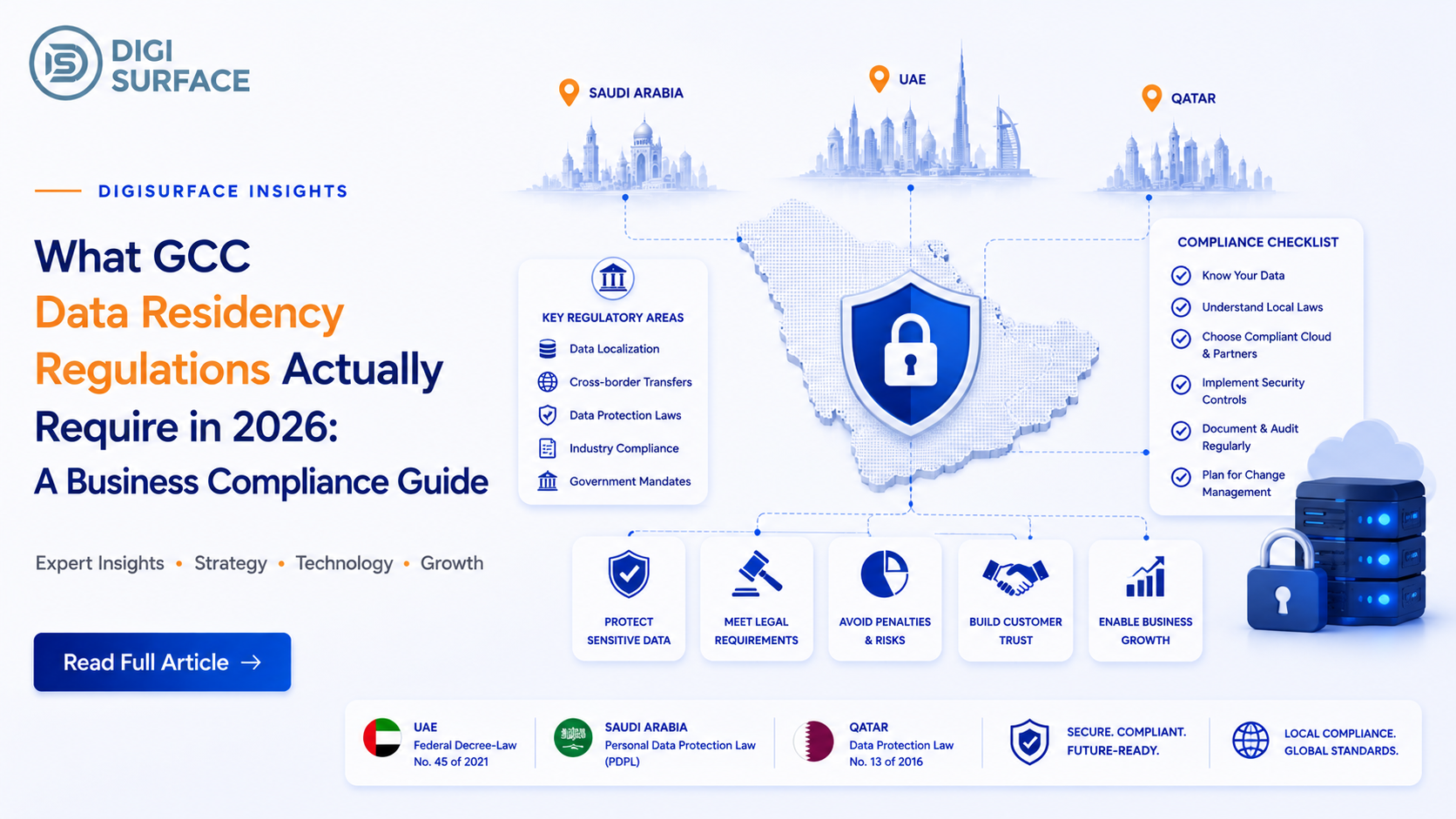
- In-country data storage — regulated sector data (banking, healthcare, government, telecom) must sit on local or approved in-region infrastructure, not just a “selected region” in a global cloud dashboard.
- AI data governance — prompts, model outputs, and training data now fall under the same residency rules as traditional databases.
- Mandatory governance roles — a documented Data Protection Officer and a provable consent trail, not just a privacy policy on a website.
- Active, penalty-backed enforcement — fines up to 5 million SAR in Saudi Arabia alone, with criminal penalties in Bahrain for serious violations.
Full country-by-country breakdown, sector-by-sector impact, and compliance architecture below
The “wait-and-see” era of GCC data protection is over. For years, enterprises could treat data residency GCC regulations as frameworks on paper published, discussed, mostly unenforced. That grace period has closed. Regulators across the region are now actively auditing businesses, enforcing local hosting requirements, and penalizing unauthorized cross-border data transfers, not waiting for a complaint to trigger action. One mistake worth correcting early: it’s tempting to treat the six-country Gulf Cooperation Council as a single compliance zone. It isn’t. Each member state enforces its own mandates through its own national authority, and a compliance strategy built for one country rarely transfers cleanly to the next.
Data Residency vs Data Sovereignty vs Data Localization: What’s Actually Different
These three terms get used interchangeably, but they answer different questions. A data residency requirement specifies where data must be physically stored which country’s servers hold it. Data sovereignty is broader: it refers to whose legal jurisdiction governs that data, regardless of where it physically sits, meaning even in-country storage doesn’t automatically resolve every sovereignty question if the processing entity is foreign-controlled. Data localization is the practical mandate that ties the two together with a specific legal requirement that certain categories of data must be stored and processed within national borders, full stop, with no cross-border exception. In the GCC, most 2026 regulations combine all three: data localization requirements for sensitive sectors, layered under broader data sovereignty expectations, enforced through specific residency rules.
Core Requirements Across the GCC in 2026
Regardless of which country a business operates in, a handful of requirements now show up consistently across the region:
- In-country data storage for regulated sectors banking, healthcare, government, and telecommunications data must physically reside on local servers or approved in-region cloud infrastructure, not simply a “selected region” in a global cloud dashboard
- AI data governance this is one of the more significant 2026 shifts: prompts, model outputs, fine-tuning datasets, and user logs from AI tools now fall under the same residency expectations as traditional databases, meaning a generative AI tool routing queries through servers outside the country can create the same exposure as a non-compliant database
- Mandatory governance roles several jurisdictions now require an appointed Data Protection Officer and documented, provable user consent, not just a privacy policy on a website
- Heavy financial penalties for violations non-compliance, data leaks, or unauthorized transfers can draw significant fines; in Saudi Arabia, SDAIA has issued penalties up to 5 million SAR for illegal data exits, with steeper penalties for repeat offenders
Country-by-Country: What Each GCC Regulator Actually Requires
| Country | Law | Regulator | 2026 Status |
| Saudi Arabia | PDPL | SDAIA | Fully enforced since September 2024; penalties up to 5 million SAR for illegal data exits, with local Azure region expansion easing in-country AI processing |
| UAE | Federal Decree-Law 45/2021 | UAE Data Office / DIFC / ADGM | Fully active; 2026 Executive Regulations clarify cross-border transfer mechanics; public sector and financial workloads face mandates to migrate off legacy on-premise systems to local sovereign cloud |
| Oman | PDPL | MTCIT / CITA | Executive Regulations fully in force since February 2026; mandatory DPO appointment and formal consent trails for handling citizen data |
| Qatar | Law No. 13/2016 | NCSA, plus Qatar Central Bank for financial services | In force; Qatar Central Bank separately enforces strict cloud computing and local hosting rules for financial operations |
| Bahrain | PDPL (2018/2019) | DPA | In force; strictest enforcement regime in the region, including criminal penalties |
| Kuwait | CITRA Data Privacy Regulation (2024) | CITRA | Limited scope, applying only to CITRA-licensed service providers; a comprehensive national law is still pending |
Oman’s regulatory backdrop deserves particular attention for enterprises weighing CITA Oman data sovereignty requirements specifically the Communications and Information Technology Regulatory Authority oversees telecom and broader data compliance in the country, and its 2026 Executive Regulations closed what had been, for years, a framework that existed on paper without active enforcement behind it.
What This Means Sector by Sector
Residency obligations don’t land the same way across every industry. Here’s how they typically show up in practice:
- Banking and financial services the most tightly regulated category across every GCC country; transaction records, customer financial data, and increasingly AI-driven risk models must stay in-country, often under sector-specific rules layered on top of general data protection law
- Healthcare patient records, diagnostic data, and increasingly AI-assisted diagnostic tools fall under some of the strictest residency requirements, given the sensitivity of medical information
- HRMS and payroll employee data, particularly payroll figures tied to national wage protection systems, is treated as sensitive personal data requiring in-country processing in most jurisdictions
- Real estate buyer and transaction data, especially where foreign investment or financing is involved, increasingly falls under residency scrutiny as property technology platforms scale across borders
- Logistics supply chain and shipment data crossing multiple GCC countries creates one of the more complex compliance pictures in the region, since a single shipment’s data may legally need to satisfy several countries’ residency rules at once
How GCC Rules Compare to India’s DPDP Act
For enterprises operating across both regions, it’s worth understanding that India’s approach is structured differently. India’s Digital Personal Data Protection Act, 2023, and its Rules (notified November 13, 2025) are rolling out in phases. The Data Protection Board was established immediately, the Consent Manager framework became operational in November 2026, and the substantive provisions came into full force on May 13, 2027. Until that date, India’s older Information Technology (Reasonable Security Practices and Procedures and Sensitive Personal Data or Information) Rules, 2011 commonly called the SPDI Rules remain technically in force, since the DPDP Act doesn’t repeal them outright until its later provisions activate.
The bigger structural difference is the cross-border model itself:
| GCC Model | India (DPDP Act) Model | |
| Default posture | Residency-first in-country storage required for regulated sectors | Cross-border transfer allowed by default |
| Cross-border transfers | Generally restricted or requires specific approval | Permitted globally unless a country is explicitly restricted |
| Enforcement stage (2026) | Active, penalty-backed enforcement | Phased rollout, full enforcement from May 2027 |
For a business running operations in both regions, this means two genuinely different compliance postures are needed; a GCC strategy built around “keep it in-country by default” doesn’t map directly onto India’s “allowed unless restricted” approach, and vice versa.
Data Localization Requirements in Practice: Building Compliant Infrastructure
Satisfying these requirements architecturally means going beyond selecting a regional setting in a cloud provider’s dashboard. For traditional data workloads, that typically means in-country data centers or approved sovereign cloud infrastructure, with data lineage and audit trails built in from the start rather than added after a regulator asks. For AI workloads specifically, the same principle now applies with added complexity: on-premise AI for GCC deployments have become the more reliable path for regulated sectors, since a cloud AI tool can process prompts and generate outputs on servers outside the country even when its dashboard shows a Gulf region selected. The distinction matters: a “region setting” is a configuration choice a vendor can change; an on-premise deployment is an architectural guarantee that doesn’t depend on a third party’s infrastructure decisions.
How DigiSurface Delivers PDPL Compliance Solutions Across the GCC
This isn’t a theoretical framework for DigiSurface, it’s work already delivered in production. DigiSurface built an enterprise BI data lake for the Central Bank of Oman on Oracle Cloud Infrastructure, designed specifically to support regulatory reporting and financial stability monitoring without data ever leaving the country a direct, verified example of the exact residency and governance requirements outlined above. Beyond that engagement, DigiSurface’s PDPL compliance solutions GCC work spans the sectors covered in this guide:
- Banking and financial services compliant data pipelines and reporting infrastructure built around in-country processing requirements
- Healthcare data architecture designed around sector-specific residency and consent requirements
- HRMS and payroll India and GCC localization support, including GOSI, WPS, PF, ESI, and TDS compliance built directly into system architecture
- Real estate and logistics data infrastructure that accounts for cross-border data flows without violating in-country residency rules
- On-premise and hybrid AI deployment for organizations that need AI capabilities without the residency exposure of cloud-only tools
Frequently Asked Questions
What is a data residency requirement?
A data residency requirement is a legal rule specifying where a category of data must be physically stored, typically requiring it to remain within the borders of the country where it was collected. It’s distinct from data sovereignty, which concerns whose laws govern the data regardless of location.
What are the data residency laws in India?
India’s data residency landscape is currently governed by a mix of the older SPDI Rules (2011) and the newer Digital Personal Data Protection Act, 2023, which is being phased in through May 2027. Unlike most GCC frameworks, India’s DPDP Act does not require blanket in-country storage; instead, it permits cross-border data transfers by default unless the government specifically restricts a destination country.
Are SPDI rules still applicable in India?
Yes, as of 2026 the SPDI Rules remain technically in force in India. The DPDP Act does not repeal them immediately; they are expected to be superseded once the DPDP Act’s remaining provisions, including Section 44(2) of the Act, take effect on May 13, 2027. Until that date, both regimes effectively coexist.
Is there a GDPR equivalent in India?
India’s Digital Personal Data Protection Act, 2023 is often described as India’s answer to the GDPR, though its structure differs meaningfully notably in its more permissive, “allowed unless restricted” approach to cross-border data transfers, compared to the GDPR’s more restrictive adequacy-based model.
What is the difference between data sovereignty and data residency?
Data residency refers specifically to the physical location where data is stored. Data sovereignty is the broader principle that data is subject to the laws of the country in which it is collected or processed, regardless of where it’s physically stored meaning a dataset can satisfy residency requirements while still raising sovereignty questions if it’s processed by a foreign-controlled entity.
What happens if a business violates GCC data residency regulations?
Penalties vary by country but are increasingly significant. Saudi Arabia’s SDAIA has issued fines up to 5 million SAR for illegal data transfers, and Bahrain’s enforcement regime includes criminal penalties for serious violations. Beyond fines, non-compliant businesses risk audit findings, forced remediation, and reputational damage with regulators and customers alike.
Build Compliance Into the Architecture, Not After the Audit
GCC data residency regulations in 2026 aren’t a checklist to satisfy once and forget they’re an active, evolving enforcement environment that rewards businesses who design for compliance from the start. If your organization operates across real estate, banking, HRMS, logistics, or healthcare in the GCC,
Book a consultation with DigiSurface to map your specific residency exposure and build infrastructure that holds up under real regulatory scrutiny, not just a dashboard setting.