
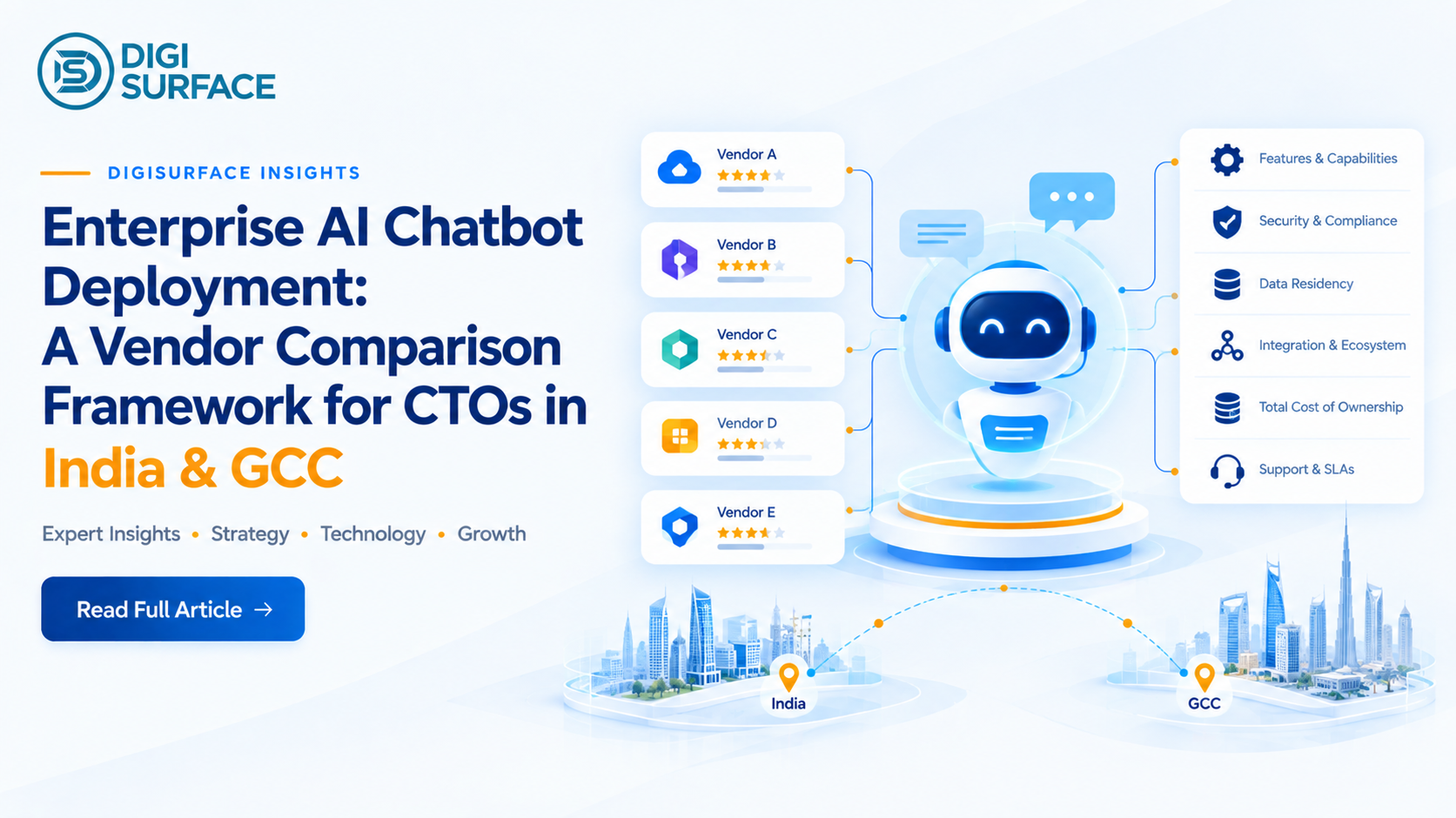
For CTOs in India and the GCC, enterprise AI chatbot deployment isn’t a single decision; it’s three linked decisions: which hosting model satisfies your regulatory obligations, which vendor category fits your actual use case, and how much architectural complexity your integration requirements demand. Global cloud vendors (Azure OpenAI, Google Vertex AI, AWS Bedrock) offer strong ecosystem integration but route data through hyperscaler infrastructure that must be explicitly region-locked to meet local law. Regional and on-premises-capable platforms (including DigiSurface’s own Sentinel) satisfy data residency requirements by architecture rather than by a configurable region setting the difference that matters most for banking, government, and healthcare deployments under Saudi Arabia’s NDMO, the UAE’s PDPL, or India’s DPDP Act and RBI cross-border data rules.
If you’re evaluating enterprise AI chatbot vendors and data residency, integration complexity, or unpredictable API costs are part of that decision, use the comparison framework below before you shortlist a vendor. Book a free architecture consultation →
Why This Decision Isn’t a Feature Checklist
Most vendor comparisons for AI chatbots focus on model quality and conversation accuracy. For CTOs in India and the GCC, that’s the wrong starting point. The first filter isn’t “which model is smartest”; it’s “which hosting model is legally defensible for this specific data.” A brilliant conversational model connected to the wrong hosting architecture is a compliance liability before it’s a customer service asset.
The Vendor Landscape: A Comparison Matrix
| Platform | Deployment Model | Regional Language Strength | Core Strength | Data Residency |
| Microsoft Azure OpenAI | Hybrid/Cloud | High (multilingual GPT models) | Microsoft ecosystem integration | Azure regions in UAE, Qatar, India |
| Google Cloud Vertex AI | Hybrid/Cloud | High (Gemini multilingual) | Search and data grounding | Google Cloud regions in KSA, Qatar, India |
| AWS Bedrock | Cloud-native | Moderate–High | Multi-model flexibility | AWS regions in UAE, India |
| Kore.ai | On-premise/Cloud | Strong regional NLP | No-code enterprise orchestration | Flexible, including private cloud/on-premise |
| Yellow.ai | Hybrid/Cloud | Strong regional NLP | Omni-channel automation | Multi-region local hosting |
| DigiSurface Sentinel | On-premise/Private cloud | Region-tunable, India/GCC-focused | Data control, unlimited-user pricing, direct database Q&A | Full control data never leaves the organization’s infrastructure |
The three global hyperscalers offer a “regional data center” setting in their dashboards a configuration choice, not an architectural guarantee. The regional and on-premises-first platforms, Sentinel included, close that gap by design.
Three Evaluation Pillars That Matter More Than Feature Lists
1. Data Sovereignty and Regulatory Compliance
GCC deployments must account for Saudi Arabia’s NDMO (National Data Management Office) requirements and the UAE’s PDPL, with in-country hosting or on-premises architecture effectively mandatory for government and banking sectors. India deployments fall under the DPDP Act, with financial institutions additionally facing RBI expectations around cross-border data flows for sensitive user data. None of these are satisfied by a cloud vendor’s region picker alone; they require the underlying infrastructure and data pipeline to actually stay in-country.
2. Linguistic and Cultural Accuracy
A chatbot’s real-world usefulness depends heavily on handling regional language nuance, not just “supports Arabic” or “supports Hindi” as a checkbox. In the GCC, Standard Modern Arabic often isn’t sufficient for consumer-facing use; regional dialects and Arabizi (Arabic written in Latin characters) need to be handled directly. In India, code-switching between English and Indic languages (“Hinglish,” “Tanglish”) is the norm in real conversations, not the exception, and a platform that only handles clean single-language input will underperform against real usage patterns.
3. Total Cost of Ownership
Global cloud vendors typically charge per API token a pricing model that scales unpredictably as usage grows, which becomes a real budgeting problem for high-volume consumer applications. On-premises and self-hosted LLMs for enterprise deployments trade a higher upfront infrastructure cost for a flatter, more predictable cost curve at scale, often the more defensible model for Tier-1 banks and telecom providers running high query volumes.
Architecture and Deployment: What “Enterprise-Grade” Actually Requires
A production-ready enterprise AI chatbot deployment needs a defined architecture around the model itself, not just the model:
- Security and identity: OAuth 2.0 or SAML-based identity management, private network isolation, and a web application firewall protecting the chatbot’s entry points
- Data ingestion and processing: a pipeline that cleans, chunks, and securely indexes internal documents so the chatbot can retrieve accurate answers (commonly called Retrieval-Augmented Generation, or RAG) rather than relying purely on a general-purpose model’s training data
- System integrations: direct connections into existing ERP, CRM, and knowledge base systems, rather than a chatbot operating as an isolated, disconnected layer
Hosting models, by regulatory need:
| Model | Infrastructure | Typical Deploy Time | Cost | Best For |
| Multi-tenant SaaS | Shared cloud | Days to weeks | Lowest | Standard operations, fast time-to-market |
| Single-tenant cloud | Dedicated cloud | Weeks | 2–3x higher | High isolation requirements |
| On-premise/private cloud | Internal network | Longest | Highest upfront | Heavily regulated sectors (banking, healthcare, government) |
Deployment complexity, by scope:
- Low complexity (roughly 3–5 weeks): a single web widget answering from a limited, static knowledge base with no backend integration
- Mid complexity (roughly 8–12 weeks): multi-channel deployment (web, WhatsApp, Teams) integrated into CRM or ticketing systems with human-agent escalation
- High complexity (roughly 16–24 weeks): a full enterprise conversational platform spanning multiple languages, transactional workflows, and multi-system orchestration
These are directional industry ranges, not fixed timeline actual duration depends heavily on how many systems the chatbot needs to integrate with and how clean the underlying knowledge base already is.
How DigiSurface’s Sentinel Fits the On-Premise AI Chatbot Category
Sentinel, DigiSurface’s own AI platform, is built specifically for the pattern this article describes: organizations that need conversational AI capable of querying their own data directly, without the per-seat licensing penalties or data-residency exposure of cloud-only tools. Unlike the global hyperscalers, Sentinel supports full on-premises deployment, meaning data never has to leave the organization’s own infrastructure, which matters directly for banks, GCC public sector entities, and India-based financial institutions navigating RBI’s cross-border data expectations.
DigiSurface’s on-premises AI chatbot and self-hosted LLM for enterprise deployments are built around the same regulatory landscape covered above, drawing on direct experience delivering residency-compliant infrastructure including the enterprise data platform built for the Central Bank of Oman on Oracle Cloud Infrastructure, designed specifically to keep regulated data within the country.
Frequently Asked Questions
What is an on-premises AI chatbot?
An on-premises AI chatbot is deployed entirely on an organization’s own infrastructure or private cloud, rather than a third-party cloud provider’s servers, meaning conversation data, documents, and model outputs never leave the organization’s own network, which is often a compliance requirement in regulated sectors.
How long does enterprise AI chatbot deployment take?
Timelines vary by complexity: a basic web-based chatbot with limited integrations can deploy in roughly 3–5 weeks, a multi-channel deployment integrated with CRM systems typically takes 8–12 weeks, and a full enterprise conversational platform spanning multiple languages and systems can take 16–24 weeks or more.
Is on-premises AI more expensive than cloud AI?
On-premises AI typically requires a higher upfront infrastructure investment than a cloud-based, pay-per-token model. At high query volumes, however, the flatter, more predictable cost structure of on-premises or self-hosted deployment often becomes more cost-effective than a cloud vendor’s per-token pricing, which scales unpredictably as usage grows.
What data residency laws apply to AI chatbots in the GCC and India?
In the GCC, Saudi Arabia’s NDMO requirements and the UAE’s PDPL generally require in-country hosting for sensitive sectors like banking and government. In India, the DPDP Act governs personal data processing, with the RBI additionally expecting financial institutions to avoid cross-border transfer of sensitive user data.
Can a chatbot handle Arabic and Indic languages accurately?
Accuracy depends heavily on the specific platform. Standard Modern Arabic support alone is often insufficient for GCC consumer applications, since real usage includes regional dialects and Arabizi. Similarly, Indian deployments need to handle code-switching between English and Indic languages, not just single-language input, to reflect how people actually communicate.
What’s the difference between multi-tenant SaaS and on-premise chatbot deployment?
Multi-tenant SaaS deploys fastest and cheapest but shares infrastructure with other customers on a cloud provider’s servers. On-premise deployment takes longer and costs more upfront but keeps all data within the organization’s own network the deciding factor for most regulated-sector deployments in India and the GCC.
The Right Vendor Depends on Where Your Data Legally Has to Live
Feature comparisons matter less than they seem to once data residency enters the conversation a technically excellent chatbot built on the wrong hosting model is a compliance problem waiting to surface.
Book a free architecture consultation with DigiSurface to map which deployment model actually fits your regulatory environment before you shortlist vendors.