
It’s 11 PM before month-end closes, and an HR head is reconciling two spreadsheets that were never meant to talk to each other, one tracking PF and ESI deductions for the India office, another tracking WPS and GOSI filings for the Riyadh team. Neither system knows the other exists, so every discrepancy gets caught by hand, if it gets caught at all. This scene plays out every month at enterprises running payroll across India and the GCC on tools built for one country at a time. It’s not a staffing problem or a training gap, it’s what happens when the underlying software was never designed to hold two regulatory pictures at once. D365 HRMS and Payroll exist specifically to make that scene stop happening.
What Is D365 HRMS and Payroll?
D365 HRMS and Payroll is a payroll management system built on Microsoft Dynamics 365 that combines HR record-keeping with payroll processing, statutory compliance, and reporting in a single platform rather than running separate HRMS and payroll tools that need to be manually reconciled against each other every cycle.
India vs GCC Payroll Compliance at a Glance
Before getting into what a unified system solves, it helps to see just how different these two regulatory environments actually are:
| Requirement | India | GCC |
| Statutory deductions | PF, ESI, TDS | GOSI (Saudi), pension schemes vary by country |
| Wage protection | Not a standalone system | WPS (Wage Protection System) mandatory in most GCC countries |
| Tax filing | GST-linked reporting, TDS returns | Varies by country; several have no personal income tax |
| Filing frequency | Monthly and annual filings | Monthly WPS submissions, periodic GOSI reporting |
| Regulator | EPFO, ESIC, Income Tax Department | Country-specific (GOSI, MOL, MHRSD, etc.) |
None of these requirements overlap, which is exactly why a single-country tool built around only one column of this table struggles the moment an enterprise operates across both. Compliance calendars don’t sync either: India’s TDS returns run on a different filing rhythm than a GCC country’s monthly WPS submission, which means a system built with only one region’s calendar in mind ends up forcing manual workarounds for the other, every single cycle.
Why Generic HR Payroll Software Falls Short for Multi-Country Operations
Most HR payroll software on the market is built around one country’s compliance rules, with everything else treated as a customization or a workaround. This is where the distinction between generic HR payroll management software and a purpose-built multi-country system matters most: running India and GCC operations on tools designed for a single region usually means duplicate employee data entry across systems, payroll reports that don’t reconcile against each other, and compliance gaps that stay invisible right up until an audit finds them. The 11 PM spreadsheet reconciliation isn’t a process failure it’s what happens when the underlying software was never built to hold both regulatory pictures at once.
Signs Your Organization Has Outgrown Single-Country Payroll Tools
A few patterns tend to show up consistently once an enterprise has outgrown what its current payroll setup can handle:
- HR or finance manually cross-checks numbers between two or more systems every payroll cycle
- A new country or entity requires standing up an entirely separate payroll tool, rather than configuring the existing one
- Compliance updates (a new GOSI rate, a TDS slab change) require IT intervention rather than a routine system update
- Payroll reporting can’t be viewed centrally leadership sees India numbers and GCC numbers as two disconnected reports, never one
If two or more of these sound familiar, that’s usually the point where a unified system stops being a nice-to-have and starts being the more cost-effective option.
Top Benefits of a D365-Based Payroll Management System
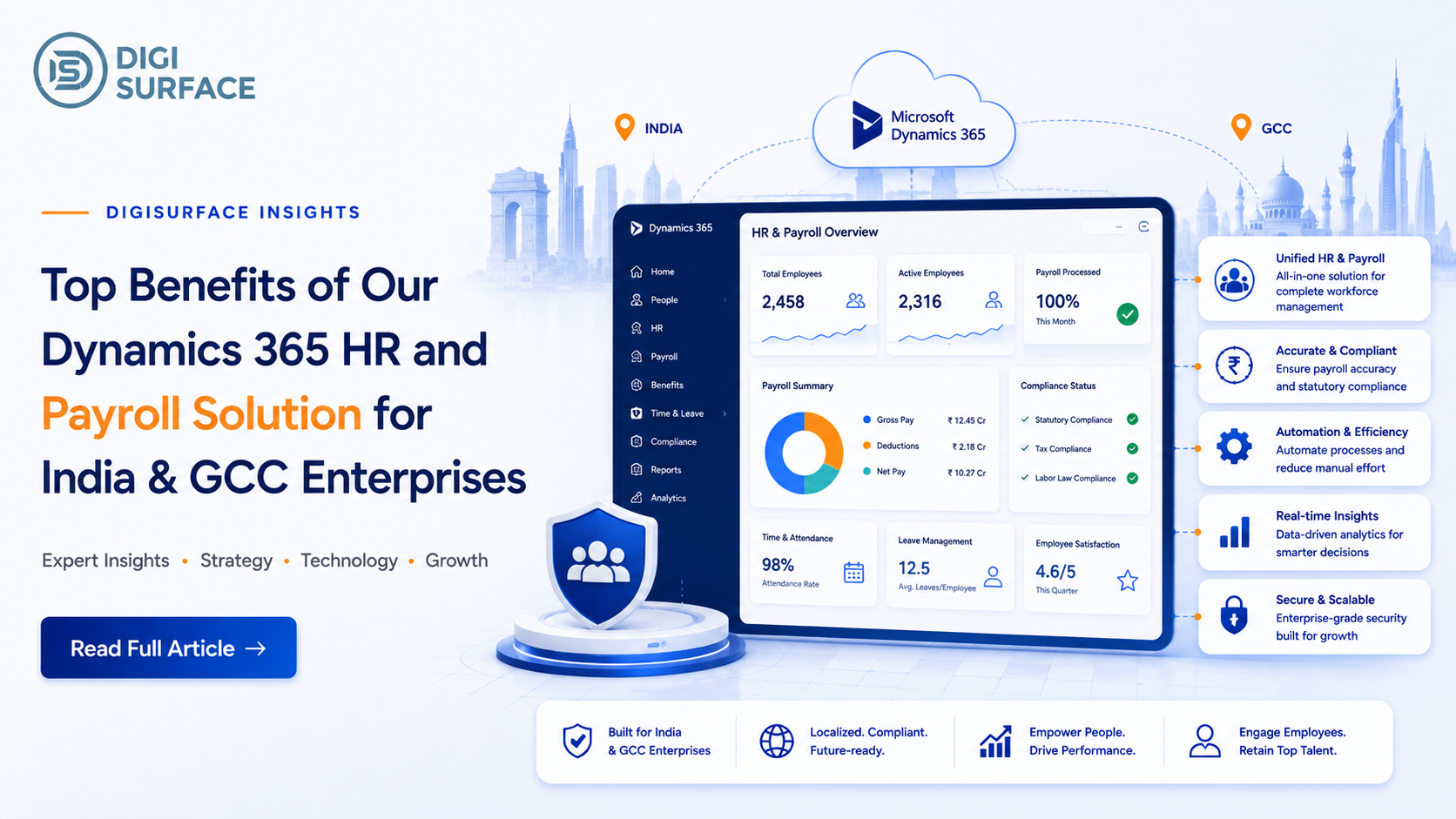
Once HR and payroll run on the same Dynamics 365 foundation, several benefits show up immediately:
- Unified HRMS and payroll– one system instead of stitching together separate HR and payroll tools that were never designed to sync
- Built-in multi-country compliance– GST, PF, ESI, and TDS for India; WPS and GOSI for the GCC, handled within the same platform rather than as bolt-on modules
- Real-time reporting– Power BI-driven visibility into payroll costs and HR metrics across every location, in one dashboard instead of several
- Scalability– adding a new country or entity means configuring the existing system, not standing up a new one from scratch
- Reduced manual errors– automated calculations replace manual reconciliation across disconnected spreadsheets, closing the exact gap that causes the 11 PM scramble
Cloud-Based Payroll Software vs Traditional On-Premise HR Systems
The deployment model matters almost as much as the compliance coverage itself:
| Traditional/On-Premise HR Payroll | Cloud Based Payroll Software (India/GCC) | |
| Multi-country compliance | Manual updates per region | Built-in, centrally maintained |
| Access | Location-locked | Accessible across offices and countries |
| Updates for regulatory change | IT-dependent, slower to roll out | Vendor-managed, faster rollout |
| Reporting | Siloed per location | Centralized, real-time |
| Scaling to a new country | Significant rebuild | Configuration, not rebuild |
How DigiSurface Delivers D365 HR Payroll for India & GCC Enterprises
This isn’t a theoretical feature list, it’s work DigiSurface has done directly for enterprises operating across both regions. DigiSurface’s D365 HR payroll implementations handle:
- India localization– GST-linked reporting, PF, ESI, and TDS configuration built directly into Dynamics 365, not layered on as a separate add-on
- GCC localization– WPS and GOSI compliance configured for country-specific requirements across Saudi Arabia, the UAE, Oman, and beyond
- Single-platform HRMS and payroll– one system for HR records and payroll processing, eliminating the reconciliation work between separate tools
- Ongoing compliance updates– reconfiguration as regulatory requirements change, rather than a support ticket every time a rate or filing rule shifts
Frequently Asked Questions
What is D365 HRMS and Payroll?
D365 HRMS and Payroll is a payroll management system built on Microsoft Dynamics 365 that combines HR record-keeping with payroll processing and statutory compliance in a single platform, allowing organizations to manage employee data, payroll calculations, and regulatory reporting without relying on separate, disconnected systems.
Can one payroll system handle both India and GCC compliance requirements?
Yes, when the system is specifically configured for both regions. A properly localized D365 HR payroll implementation can handle India’s PF, ESI, TDS, and GST-linked reporting alongside GCC requirements like WPS and GOSI within the same platform, rather than requiring separate tools for each region.
What’s the difference between HRMS and a payroll management system?
HRMS (Human Resource Management System) typically covers employee records, attendance, and HR processes, while a payroll management system focuses specifically on wage calculation, statutory deductions, and compliance filing. A combined HRMS and payroll solution merges both functions into a single platform, reducing the need to reconcile data between two separate systems.
Is cloud based payroll software secure for sensitive employee data?
Cloud based payroll software in India and the GCC, from established providers like Microsoft, typically includes enterprise-grade security, role-based access controls, and compliance certifications, making it a secure option for handling sensitive employee and payroll data when properly configured and localized for regional data requirements.
Stop Reconciling Payroll by Hand Every Month
If your organization is still manually cross-checking payroll numbers between an India system and a GCC system every cycle, that’s a solvable problem, not a permanent cost of doing business across both regions.
Book a consultation with DigiSurface to see what a unified D365 HR and Payroll setup looks like for your specific mix of countries and entities.