
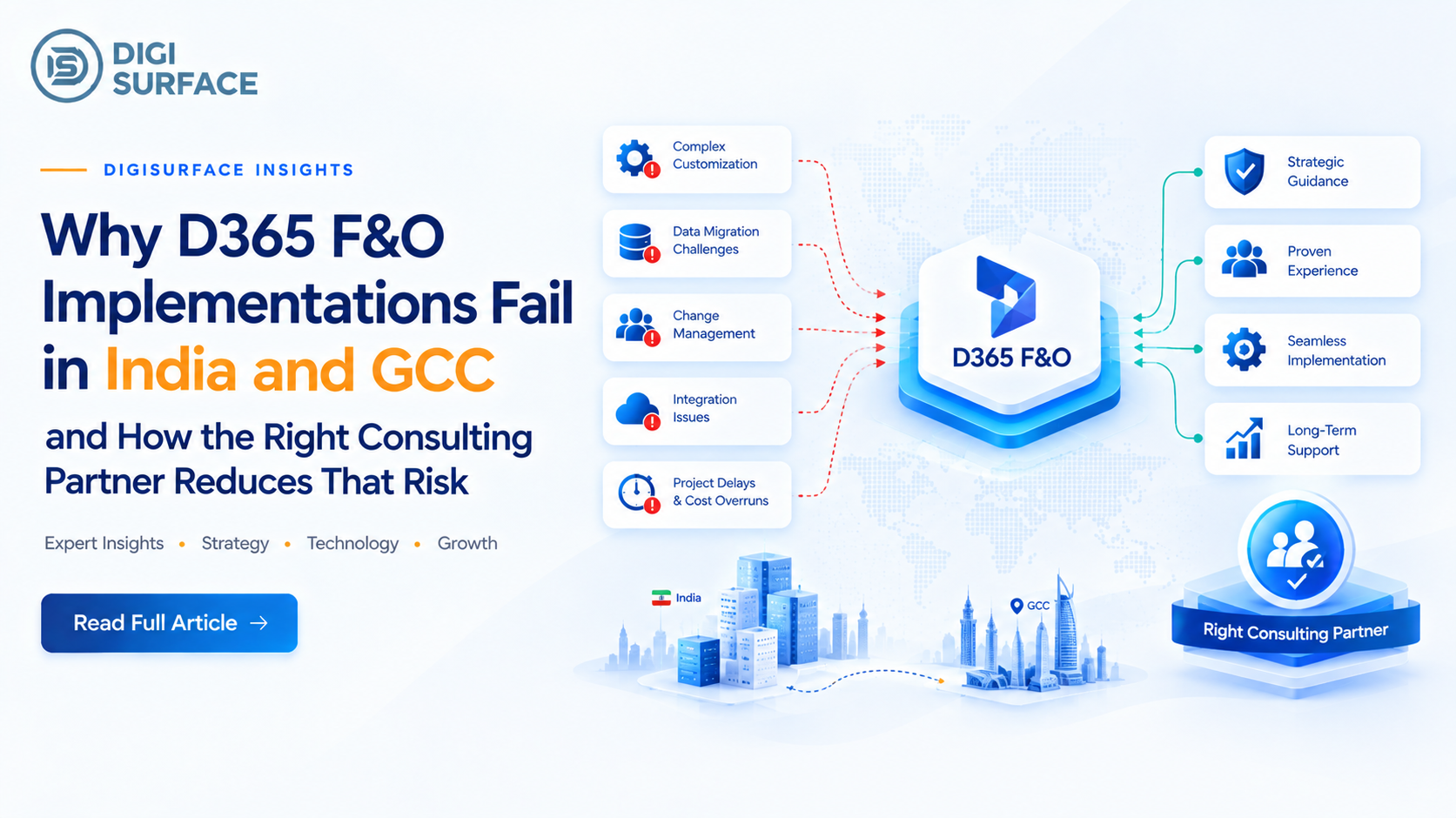
Why D365 F&O Implementations Fail in India and the GCC
- Fit-gap analysis gets skipped or rushed, so budget-breaking gaps surface mid-implementation instead of before it starts
- Localization is treated as an add-on, not a core requirement. India’s GST/PF/ESI/TDS and the GCC’s GOSI/WPS/VAT aren’t edge cases
- Partners lack real multi-entity, multi-country experience, and force every region into an identical template that doesn’t fit local rules
- Buyers still check for the wrong credential: Microsoft retired Gold/Silver partner badges in 2022 in favor of the Solutions Partner for Business Applications designation
Full 5-point partner evaluation framework and what separates a real Solutions Partner engagement from a generic implementation shop below.
Already Mid-Implementation and Behind Schedule? Run your current partner or any candidate you’re evaluating through the 5-point framework in this article before you sign anything else. Book a free consultation with DigiSurface →
Most Dynamics 365 Finance & Operations implementations in India and the GCC don’t fail because of the software; they fail because of who was hired to implement it. Gartner projects that by 2027, more than 70% of recently implemented ERP initiatives will fail to fully meet their original business goals. Microsoft has also retired its old Gold and Silver partner tiers in favor of the Solutions Partner for Business Applications designation, introduced when its partner program was overhauled in 2022. Most buyers evaluating a Dynamics 365 F&O consulting company still don’t know to check for it.
DigiSurface has run multi-country D365 F&O rollouts, including a multi-country deployment for COFCO International, built around the same fit-gap, localization, and vendor-evaluation discipline this article breaks down below.
Why D365 F&O Implementations Actually Fail
Gartner projects that more than 70% of recently implemented ERP initiatives will fail to fully meet their original business goals by 2027, according to Gartner research shared via LinkedIn. That number gets treated as a software problem. It usually isn’t. Dynamics 365 Finance & Operations is a proven, widely deployed ERP; what fails is almost always the process around it the partner selected, the rigor of the discovery phase, and how seriously localization gets treated before go-live rather than after.
D365 F&O itself is a unified ERP covering finance, supply chain, and operations management in a single cloud platform, built for organizations that have outgrown disconnected tools stitched together with manual exports and reconciliation. The software isn’t the risk. The implementation is.
In India and the GCC specifically, three failure patterns show up more often than any others:
Fit-gap analysis skipped or rushed. A fit-gap analysis maps your actual “as-is” operations against what D365 F&O handles natively (“fits”) versus what needs custom development (“gaps”). Partners under time or cost pressure sometimes compress or skip this step, basing their quote on a sales call instead of a documented assessment, and the gaps discovered mid-implementation are the ones that blow both budget and timeline.
Localization treated as an add-on, not a core requirement. India’s PF, ESI, TDS, and GST-linked reporting, and the GCC’s GOSI, WPS, and country-specific VAT rules, aren’t edge cases; they’re core to whether the system actually works for a regional business on day one. Partners without direct localization experience in these frameworks tend to treat them as post-go-live patches.
No real multi-entity, multi-country track record. A partner who has configured D365 F&O for a single-country, single-currency business hasn’t necessarily solved the harder problem: standardizing processes across multiple entities, currencies, and regulatory environments without forcing every region into an identical template that doesn’t fit local requirements.
None of these are software limitations. They’re the direct result of who gets hired to run the implementation.
What a Real D365 Finance & Operations Implementation Involves
Dynamics 365 Finance and Operations (D365 F&O) is Microsoft’s cloud ERP platform, unifying finance, supply chain, and operations management for mid-to-large enterprises running multi-entity, multi-currency, or multi-country operations that a smaller, single-region system can’t handle.
A properly run D365 F&O implementation moves through a structured sequence: project governance and scope definition, fit-gap analysis, core module configuration (general ledger, accounts payable/receivable, organizational structure), configuration and testing across development and UAT environments, and a formal go-live readiness review. Each phase deserves its own scrutiny, but the phase most commonly compressed under deadline pressure is the fit-gap step, which is exactly the one that determines whether the rest of the timeline holds.
(For a full breakdown of how D365 F&O compares to another major ERP platform, see our Dynamics 365 F&O vs SAP S/4HANA comparison.)
Why Partner Certification Matters Now: The Solutions Partner Shift
This is the part most buyers evaluating a Dynamics 365 FnO consulting company still don’t know to check.
In March 2022, Microsoft announced an overhaul of its partner program, effective October 3, 2022: the legacy Gold and Silver competency badges a system that had existed for roughly two decades were retired and replaced with six Solutions Partner designations, one of which is Solutions Partner for Business Applications, covering Dynamics 365 and the Power Platform.
The change wasn’t cosmetic. Under the old system, a partner earned Gold or Silver status per individual competency, and many partners advertised broad “Gold Partner” status without that necessarily reflecting deep expertise in any one area. Under the new system, eligibility is based on a partner capability score, a composite measure across three categories: Performance, Skilling, and Customer Success calculated from data already tracked in Microsoft’s Partner Center. It’s harder to earn, and it’s specific: a partner can hold a Business Applications designation without necessarily holding Security or Data & AI, which tells you exactly where their actual depth sits.
Most GCC and India buyers are still asking prospective vendors, “Are you a Gold Partner?” a question the market retired years ago. The right question in 2026 is: “Do you currently hold the Solutions Partner for Business Applications designation?”
| Legacy Model (pre-Oct 2022) | Current Model (2026) | |
| Structure | Gold/Silver badges per competency, ~18 legacy competencies | 6 unified Solutions Partner designations |
| Relevant designation for D365 F&O | “Gold ERP” competency | Solutions Partner for Business Applications |
| Basis for qualification | Certification volume, historical | Partner capability score: Performance + Skilling + Customer Success |
| What it actually signals | A partner achieved a badge at some point | Current, measured capability, re-evaluated on an ongoing basis |
The 5-Point D365 FnO Partner Evaluation Framework
This is the framework DigiSurface uses internally, and the one we’d recommend any business use before signing with any Dynamics 365 FnO consulting company, not just us.
- Solutions Partner Certification. Confirm current Solutions Partner for Business Applications status directly, not a legacy Gold/Silver badge still sitting on a website from before 2022.
- Fit-Gap Discipline. Ask to see a sample fit-gap deliverable, not just a proposal. A partner who can’t produce one likely doesn’t run a documented process.
- Localization Depth. Ask specifically how they handle GST, PF, ESI, and TDS (India) or GOSI, WPS, and VAT (GCC). A generic “we handle compliance” answer is the clearest red flag on this list.
- Multi-Entity, Multi-Country Proof. Ask for a named reference where they ran a live multi-entity, multi-currency rollout, not a single-country deployment described in multi-country language.
- Post-Go-Live Support Model. Ask what support looks like after go-live, specifically a defined support tier and SLA, not a vague assurance of “ongoing help.”
How DigiSurface Reduces D365 F&O Implementation Risk
DigiSurface supported COFCO International’s multi-country Dynamics 365 Finance & Operations rollout across four countries, standardizing business processes and improving operational visibility across regions that had previously run on disconnected local systems a direct example of point 4 above, not a hypothetical one.
Scored against the framework above, DigiSurface’s approach is built around: documented fit-gap analysis conducted before configuration begins; India localization (GST, PF, ESI, TDS) and GCC localization (GOSI, WPS) configured directly into the implementation rather than layered on afterward, with the same compliance depth covered in our D365 HR & Payroll solution; and proven multi-entity, multi-country rollout experience through the COFCO engagement.
If your organization is currently evaluating a Dynamics 365 FnO consulting company, run every candidate including us through the five points above before signing.
Frequently Asked Questions
What does D365 Finance and Operations actually do?
D365 F&O is Microsoft’s cloud ERP platform that unifies finance, supply chain, and operations management in one system, replacing disconnected tools with shared, real-time data across an organization. It’s built specifically for mid-to-large businesses with multi-entity or multi-country complexity.
What’s the difference between D365 Finance and Operations and Business Central?
D365 F&O is built for larger, more complex, multi-entity organizations with deep customization and multi-country requirements. Business Central targets small to mid-market businesses with simpler operational structures and faster, lower-cost implementations.
What is the Microsoft Solutions Partner for Business Applications designation?
It’s one of six Solutions Partner designations Microsoft introduced in October 2022 to replace the legacy Gold/Silver competency system. It specifically certifies a partner’s demonstrated capability across Dynamics 365 and the Power Platform, based on a measured partner capability score rather than a one-time badge.
Why do D365 F&O implementations fail in India and the GCC specifically?
The most common causes are a rushed or skipped fit-gap analysis, localization (GST/PF/ESI/TDS or GOSI/WPS) treated as an afterthought rather than built into the implementation plan, and partners without genuine multi-entity, multi-country rollout experience.
Who are the implementation partners for Dynamics 365?
The Dynamics 365 partner ecosystem includes global system integrators and regional specialists holding Microsoft’s Solutions Partner for Business Applications designation. When evaluating any partner, confirm their current designation status directly with Microsoft rather than relying on a website badge alone.
How many modules does D365 F&O have?
D365 F&O covers core modules including General Ledger, Accounts Payable/Receivable, Fixed Assets, Inventory Management, Procurement, Production Control, and Human Resources, with the exact configuration depending on which capabilities a specific implementation enables.
Choosing a Partner Is a Risk Decision, Not a Formality
A 70%-plus ERP failure rate isn’t a reason to avoid D365 F&O it’s a reason to be rigorous about who implements it. Run any Dynamics 365 FnO consulting company you’re evaluating through the five-point framework above. If you want a second opinion on where a current implementation stands, or a fit-gap assessment before you start one,