
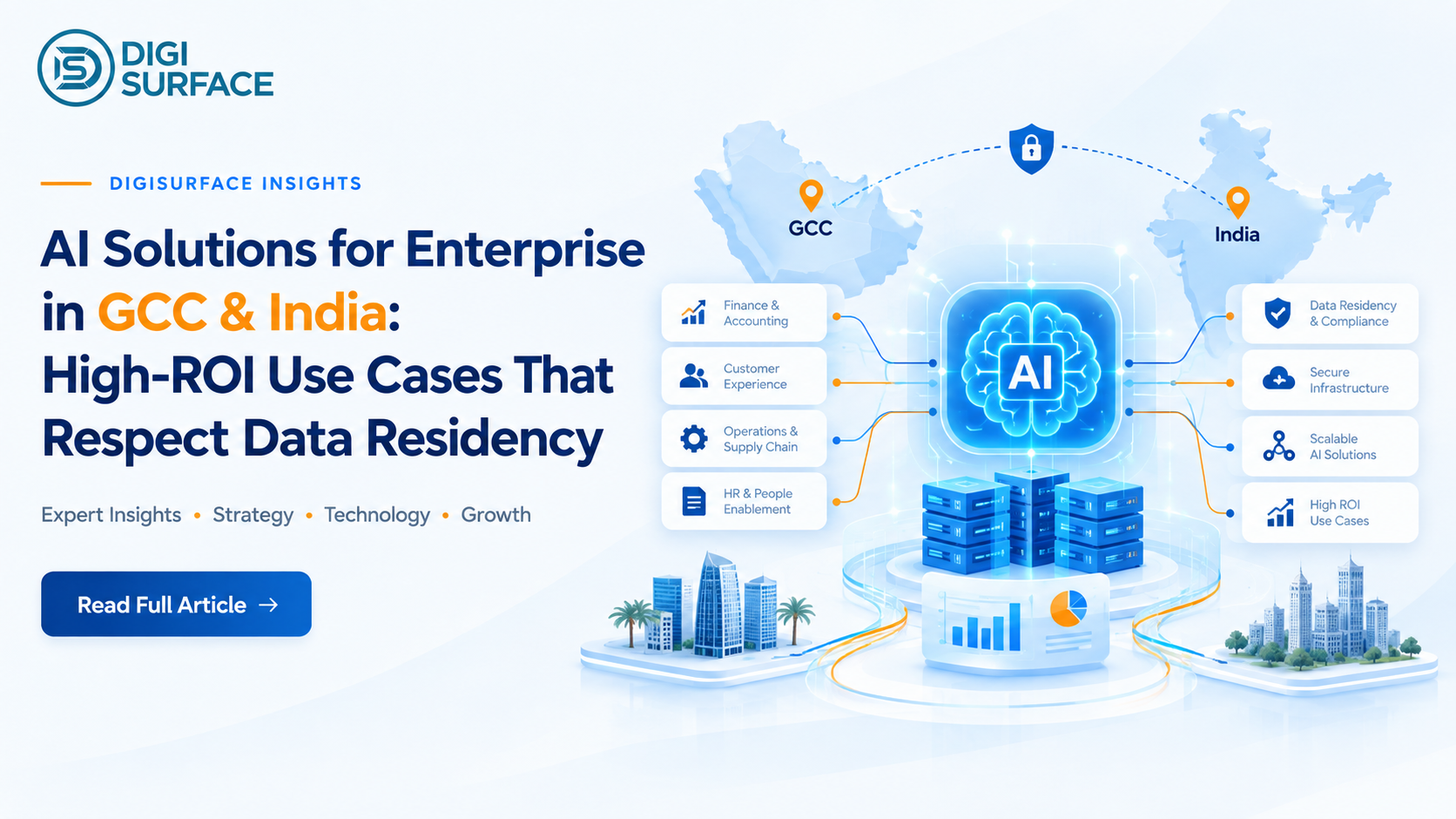
Gartner projects that conversational AI will reduce contact center agent labor costs by $80 billion globally by 2026, with one in ten agent interactions fully automated. That’s a real, attributable number, but for enterprises in the GCC and India, capturing that value isn’t as simple as deploying a cloud AI tool. Regional data protection laws, including Saudi Arabia and the UAE’s PDPL and India’s DPDP Act, mean the highest-ROI AI solutions for enterprise use are the ones architected to keep data exactly where regulation requires it: on-premises, in a private cloud, or in a regional sovereign cloud. DigiSurface builds AI solutions for enterprise clients in India and the GCC around this exact constraint, including an on-premises AI data platform delivered for the Central Bank of Oman.
If your organization is evaluating AI but data residency, compliance, or a stalled pilot is holding you back, see the three highest-ROI, residency-compliant use cases below before you choose an architecture. Book a free AI readiness assessment →
Why Enterprise AI in the GCC and India Can’t Just Copy a Global Cloud Playbook
Most enterprise AI content assumes a simple path: pick a cloud vendor, connect your data, deploy. That path runs into real friction in the GCC and India because data residency isn’t optional in either region; frameworks like Saudi Arabia’s SAMA and NCA rules, the UAE’s CBUAE requirements, regional PDPL laws, and India’s DPDP Act all apply. A “regional data center” setting in a cloud dashboard doesn’t satisfy any of these on its own; it’s a configuration choice a vendor can change, not an architectural guarantee.
This is also why so many enterprise AI pilots stall before reaching production. Gartner and ISG have each documented the pattern from different angles: governance gaps, legacy integration, and fragmented data architecture, not the AI models themselves, are the consistent cause.
The fix isn’t avoiding AI. It’s choosing an architecture that deploys exactly where the data already needs to live.
Three High-ROI AI Use Cases Built for Data Residency
These three patterns show up repeatedly across banking, logistics, and multinational operations in India and the GCC, specifically because each one has a clear, residency-compliant deployment path.
1. Intelligent Document Processing and Credit Underwriting
Financial institutions and logistics operators use AI models to automate the intake, extraction, and validation of high-volume paperwork, trade invoices, customs declarations, and credit underwriting documents. Processing time drops substantially, credit turnaround moves from days to minutes, and exceptions route to a human reviewer instead of stalling the whole queue.
The residency-safe version of this runs inside a private cloud or on-premises perimeter, with document parsing happening locally rather than sending sensitive financial records to an external service.
2. Multilingual Customer Support and Process Automation
AI-driven voice and chat agents handling customer service in Arabic, English, and Indic languages can resolve routine, tier-one inquiries around the clock, directly reducing the same contact center labor costs the Gartner figure above describes. Done well, these agents connect into existing core systems (such as SAP S/4HANA) rather than operating as an isolated chatbot layer.
The residency-safe version applies an AI firewall that redacts personal identifiers, such as a national ID number, for example, before any data log leaves the local environment, with sovereign regional hosting handling everything downstream.
3. Enterprise Workflow Automation Across Multi-Country Operations
Multinational organizations running operations across India and the GCC use AI-driven workflow automation for compliance monitoring, predictive maintenance tracking, and cross-entity supply chain coordination the same kind of multi-country complexity DigiSurface has handled on the ERP side for clients like COFCO International.
The residency-safe version keeps live operational data locked inside local infrastructure even when a team in a different country is managing or fine-tuning the underlying models, separating “who manages the system” from “where the data physically sits.”
What “Residency-by-Design” Actually Requires
Meeting these requirements isn’t a checkbox on a cloud provider’s setup screen. In practice, it requires three architectural commitments:
- Sovereign infrastructure isolation using local infrastructure or genuinely regional sovereign cloud environments, so data persistence rules are met both at rest and in transit, not just at the moment of initial storage.
- Tamper-proof audit logging – recording every action an AI agent or model takes, with timestamps and system identifiers, so a regulator can be shown a clean, verifiable record on request.
- Enterprise integration over ad-hoc uploads – connecting AI directly into existing, trusted systems and storage through secure pipelines, rather than allowing staff to copy sensitive documents into an external tool that has no contractual data-residency guarantee.
An on-premises AI chatbot or a self-hosted LLM for enterprise use satisfies all three by design, since the infrastructure decision isn’t left to a third-party vendor’s configuration settings.
How DigiSurface Delivers AI Solutions for Enterprise in India and the GCC
DigiSurface has already built exactly this kind of residency-compliant AI infrastructure in production, not as a hypothetical capability. The enterprise data and BI platform built for the Central Bank of Oman on Oracle Cloud Infrastructure was designed specifically to keep regulatory reporting and financial data inside the country, satisfying residency requirements through architecture rather than through a policy document.
DigiSurface’s AI solutions for enterprise clients in India and the GCC currently cover:
- On-premises AI chatbot deployment for organizations that need conversational AI without sending customer data outside their own infrastructure
- Self-hosted LLM for enterprise use, including model selection and fine-tuning on private infrastructure
- Document intelligence and process automation, built around the same in-country processing principle described above
- Multi-country deployment support for organizations operating across India and multiple GCC jurisdictions simultaneously
Frequently Asked Questions
What are enterprise AI solutions?
Enterprise AI solutions are AI-powered systems including chatbots, document processing tools, and workflow automation built and deployed to meet the scale, security, and compliance requirements of a large organization, as opposed to a consumer-grade or single-user AI tool.
What is enterprise AI strategy?
An enterprise AI strategy is an organization’s plan for where and how it deploys AI, including which use cases to prioritize, which data governance and compliance requirements apply, and whether workloads run in the cloud, on-premises, or in a hybrid architecture. In the GCC and India, data residency requirements are typically a core part of that strategy, not an afterthought.
Who are the top enterprise AI solution providers for India and the GCC?
The provider landscape includes global cloud AI vendors alongside regional specialists built specifically around data residency and compliance. DigiSurface is one such regional provider, having delivered on-premise and residency-compliant AI infrastructure including a production deployment for the Central Bank of Oman for enterprises across India and the GCC.
How is AI being used in enterprise operations today?
Common enterprise AI applications include document processing and underwriting automation, multilingual customer support agents, workflow automation for compliance and supply chain coordination, and knowledge assistants that help staff search internal company data using natural language.
Which AI approach is best for enterprises with strict data residency requirements?
For enterprises in regulated sectors or jurisdictions with in-country data storage requirements such as banking, healthcare, or government in the GCC and India, an on-premises or private-cloud AI deployment is generally the more defensible approach, since it satisfies residency requirements through infrastructure rather than through a vendor’s configurable region setting.
AI ROI in the GCC and India Depends on Architecture, Not Just the Model
The $80 billion figure Gartner projects for 2026 is real, and it’s achievable but only for organizations that solve the residency and governance problem before they scale a pilot into production. If your enterprise is evaluating AI solutions and data residency, compliance, or a stalled pilot is part of that conversation,
Book an AI readiness assessment with DigiSurface to map out an architecture built for how India and GCC regulation actually works, not how a generic cloud AI playbook assumes it works.