Tag: #DigitalTransformation

  • AI Solutions for Enterprise in GCC & India: High-ROI Use Cases That Respect Data Residency

    AI Solutions for Enterprise in GCC & India: High-ROI Use Cases That Respect Data Residency

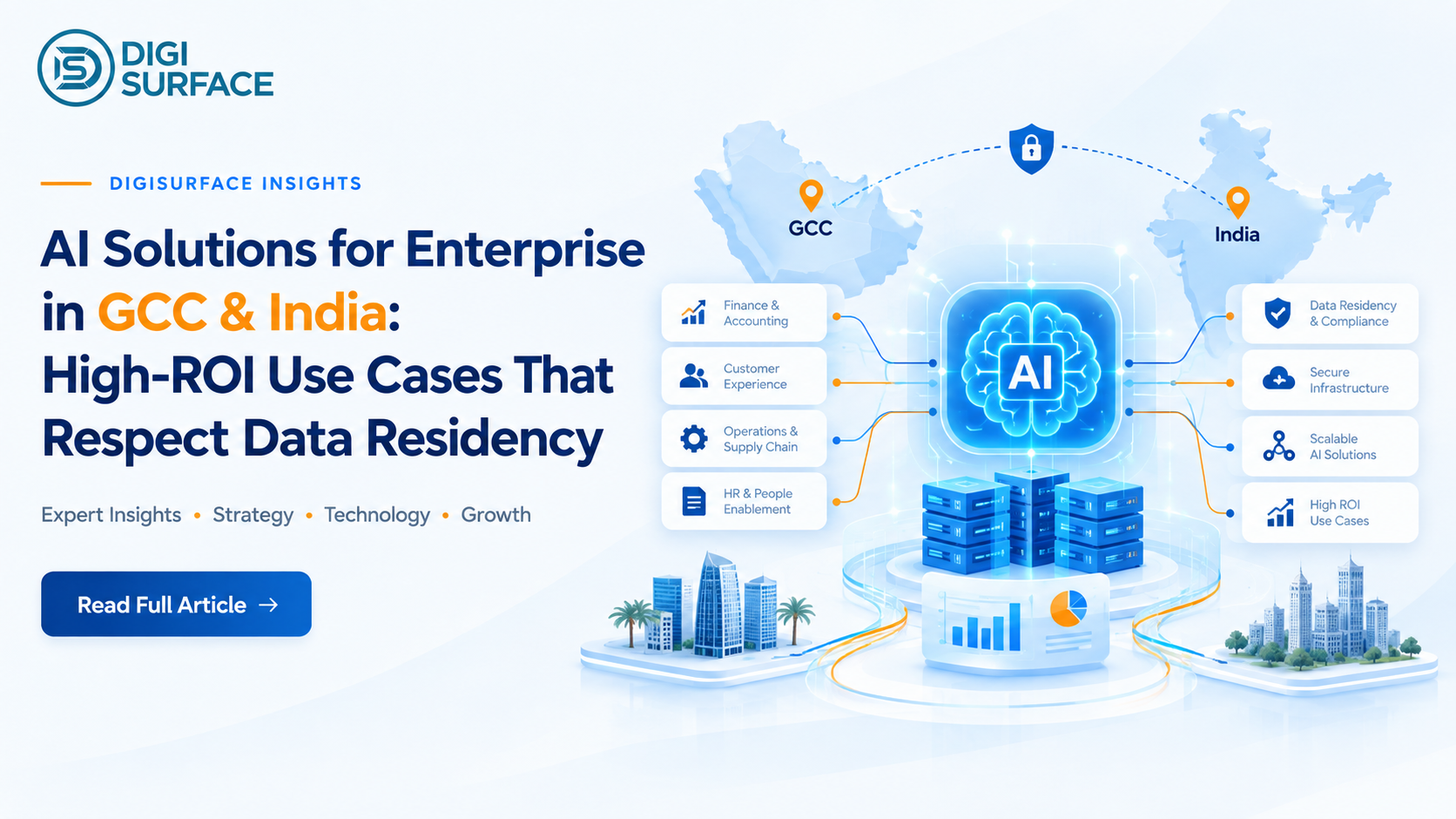
    Gartner projects that conversational AI will reduce contact center agent labor costs by $80 billion globally by 2026, with one in ten agent interactions fully automated. That’s a real, attributable number, but for enterprises in the GCC and India, capturing that value isn’t as simple as deploying a cloud AI tool. Regional data protection laws, including Saudi Arabia and the UAE’s PDPL and India’s DPDP Act, mean the highest-ROI AI solutions for enterprise use are the ones architected to keep data exactly where regulation requires it: on-premises, in a private cloud, or in a regional sovereign cloud. DigiSurface builds AI solutions for enterprise clients in India and the GCC around this exact constraint, including an on-premises AI data platform delivered for the Central Bank of Oman.

    If your organization is evaluating AI but data residency, compliance, or a stalled pilot is holding you back, see the three highest-ROI, residency-compliant use cases below before you choose an architecture. Book a free AI readiness assessment →

    Why Enterprise AI in the GCC and India Can’t Just Copy a Global Cloud Playbook

    Most enterprise AI content assumes a simple path: pick a cloud vendor, connect your data, deploy. That path runs into real friction in the GCC and India because data residency isn’t optional in either region; frameworks like Saudi Arabia’s SAMA and NCA rules, the UAE’s CBUAE requirements, regional PDPL laws, and India’s DPDP Act all apply. A “regional data center” setting in a cloud dashboard doesn’t satisfy any of these on its own; it’s a configuration choice a vendor can change, not an architectural guarantee.

    This is also why so many enterprise AI pilots stall before reaching production. Gartner and ISG have each documented the pattern from different angles: governance gaps, legacy integration, and fragmented data architecture, not the AI models themselves, are the consistent cause.

    The fix isn’t avoiding AI. It’s choosing an architecture that deploys exactly where the data already needs to live.

    Three High-ROI AI Use Cases Built for Data Residency

    These three patterns show up repeatedly across banking, logistics, and multinational operations in India and the GCC, specifically because each one has a clear, residency-compliant deployment path.

    1. Intelligent Document Processing and Credit Underwriting

    Financial institutions and logistics operators use AI models to automate the intake, extraction, and validation of high-volume paperwork, trade invoices, customs declarations, and credit underwriting documents. Processing time drops substantially, credit turnaround moves from days to minutes, and exceptions route to a human reviewer instead of stalling the whole queue.

    The residency-safe version of this runs inside a private cloud or on-premises perimeter, with document parsing happening locally rather than sending sensitive financial records to an external service.

    2. Multilingual Customer Support and Process Automation

    AI-driven voice and chat agents handling customer service in Arabic, English, and Indic languages can resolve routine, tier-one inquiries around the clock, directly reducing the same contact center labor costs the Gartner figure above describes. Done well, these agents connect into existing core systems (such as SAP S/4HANA) rather than operating as an isolated chatbot layer.

    The residency-safe version applies an AI firewall that redacts personal identifiers, such as a national ID number, for example, before any data log leaves the local environment, with sovereign regional hosting handling everything downstream.

    3. Enterprise Workflow Automation Across Multi-Country Operations

    Multinational organizations running operations across India and the GCC use AI-driven workflow automation for compliance monitoring, predictive maintenance tracking, and cross-entity supply chain coordination the same kind of multi-country complexity DigiSurface has handled on the ERP side for clients like COFCO International.

    The residency-safe version keeps live operational data locked inside local infrastructure even when a team in a different country is managing or fine-tuning the underlying models, separating “who manages the system” from “where the data physically sits.”

    What “Residency-by-Design” Actually Requires

    Meeting these requirements isn’t a checkbox on a cloud provider’s setup screen. In practice, it requires three architectural commitments:

    • Sovereign infrastructure isolation using local infrastructure or genuinely regional sovereign cloud environments, so data persistence rules are met both at rest and in transit, not just at the moment of initial storage.
    • Tamper-proof audit logging – recording every action an AI agent or model takes, with timestamps and system identifiers, so a regulator can be shown a clean, verifiable record on request.
    • Enterprise integration over ad-hoc uploads – connecting AI directly into existing, trusted systems and storage through secure pipelines, rather than allowing staff to copy sensitive documents into an external tool that has no contractual data-residency guarantee.

    An on-premises AI chatbot or a self-hosted LLM for enterprise use satisfies all three by design, since the infrastructure decision isn’t left to a third-party vendor’s configuration settings.

    How DigiSurface Delivers AI Solutions for Enterprise in India and the GCC

    DigiSurface has already built exactly this kind of residency-compliant AI infrastructure in production, not as a hypothetical capability. The enterprise data and BI platform built for the Central Bank of Oman on Oracle Cloud Infrastructure was designed specifically to keep regulatory reporting and financial data inside the country, satisfying residency requirements through architecture rather than through a policy document.

    DigiSurface’s AI solutions for enterprise clients in India and the GCC currently cover:

    • On-premises AI chatbot deployment for organizations that need conversational AI without sending customer data outside their own infrastructure
    • Self-hosted LLM for enterprise use, including model selection and fine-tuning on private infrastructure
    • Document intelligence and process automation, built around the same in-country processing principle described above
    • Multi-country deployment support for organizations operating across India and multiple GCC jurisdictions simultaneously

    Frequently Asked Questions

    What are enterprise AI solutions?

    Enterprise AI solutions are AI-powered systems including chatbots, document processing tools, and workflow automation built and deployed to meet the scale, security, and compliance requirements of a large organization, as opposed to a consumer-grade or single-user AI tool.

    What is enterprise AI strategy?

    An enterprise AI strategy is an organization’s plan for where and how it deploys AI, including which use cases to prioritize, which data governance and compliance requirements apply, and whether workloads run in the cloud, on-premises, or in a hybrid architecture. In the GCC and India, data residency requirements are typically a core part of that strategy, not an afterthought.

    Who are the top enterprise AI solution providers for India and the GCC?

    The provider landscape includes global cloud AI vendors alongside regional specialists built specifically around data residency and compliance. DigiSurface is one such regional provider, having delivered on-premise and residency-compliant AI infrastructure including a production deployment for the Central Bank of Oman for enterprises across India and the GCC.

    How is AI being used in enterprise operations today?

    Common enterprise AI applications include document processing and underwriting automation, multilingual customer support agents, workflow automation for compliance and supply chain coordination, and knowledge assistants that help staff search internal company data using natural language.

    Which AI approach is best for enterprises with strict data residency requirements?

    For enterprises in regulated sectors or jurisdictions with in-country data storage requirements such as banking, healthcare, or government in the GCC and India, an on-premises or private-cloud AI deployment is generally the more defensible approach, since it satisfies residency requirements through infrastructure rather than through a vendor’s configurable region setting.

    AI ROI in the GCC and India Depends on Architecture, Not Just the Model

    The $80 billion figure Gartner projects for 2026 is real, and it’s achievable but only for organizations that solve the residency and governance problem before they scale a pilot into production. If your enterprise is evaluating AI solutions and data residency, compliance, or a stalled pilot is part of that conversation, 

    Book an AI readiness assessment with DigiSurface to map out an architecture built for how India and GCC regulation actually works, not how a generic cloud AI playbook assumes it works.
  • Data Analytics vs Business Intelligence Consulting: What’s the Real Difference?

    Data Analytics vs Business Intelligence Consulting: What’s the Real Difference?

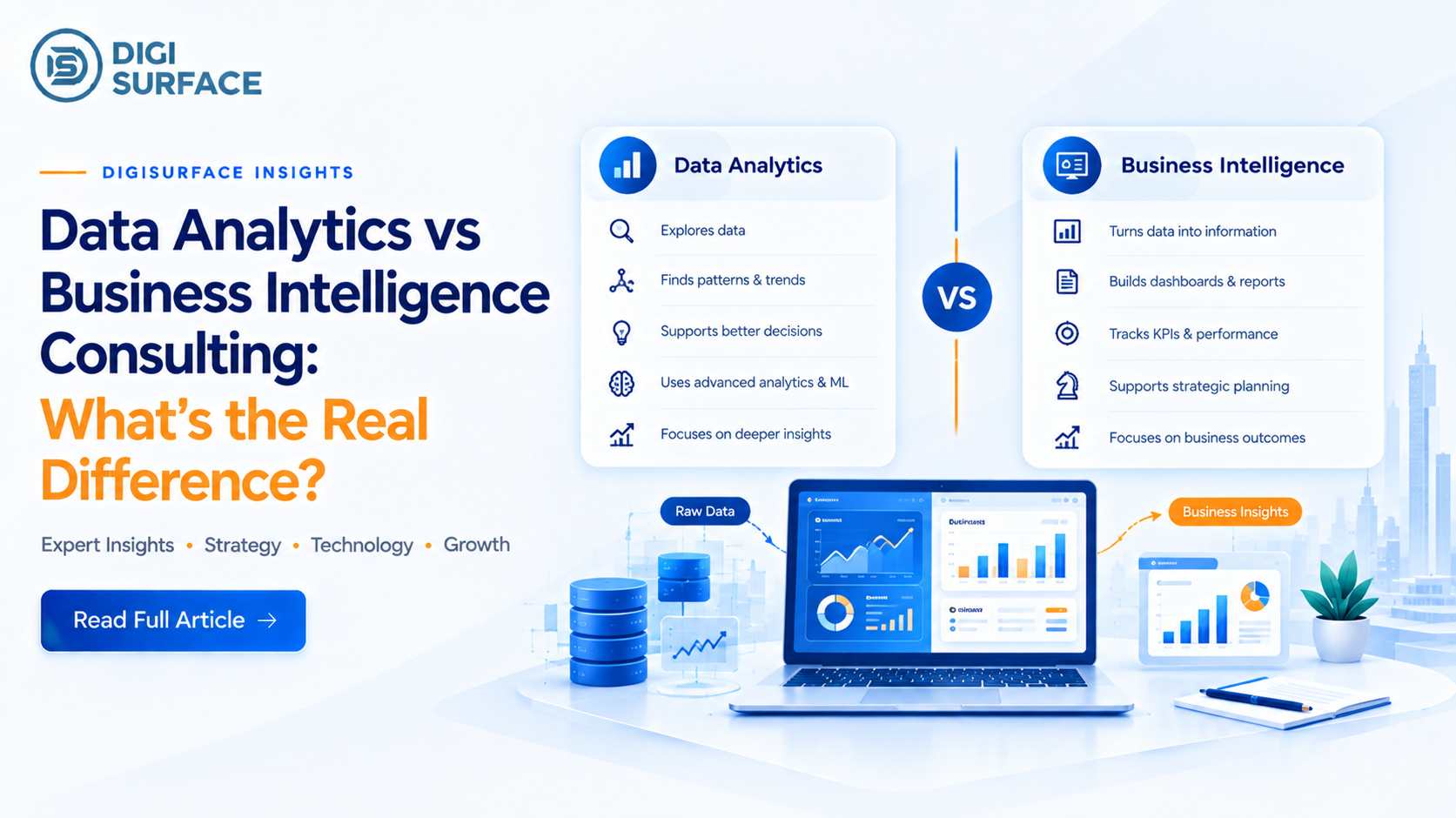
    Business intelligence (BI) consulting builds the infrastructure and dashboards that show what’s happening right now data pipelines, warehouses, and reporting. Data analytics consulting goes further, applying statistics and modeling to explain why something happened and forecast what’s likely next. They’re sequential, not competing: BI consulting establishes clean, trustworthy data architecture; data analytics consulting then runs advanced analysis on top of that foundation. The global BI and analytics market is valued at approximately $50.4B in 2026, projected to reach $95.8B by 2033 at a 9.6% CAGR. Professional services rather than software licensing account for the majority of that spend, meaning most buyers are paying for expertise and implementation, not just a tool subscription. Understanding which one you actually need and often, that you need both, in sequence determines whether that spend produces a usable system or an expensive dashboard nobody trusts.

    If you’re not sure whether your business needs BI consulting, data analytics consulting, or both use the decision framework in this article to identify exactly where your data maturity sits before you brief a vendor. Book a free data strategy consultation →

    1. BI Consulting vs Data Analytics Consulting: The Actual Difference

    The confusion is understandable both fields use overlapping tools (Power BI, Tableau, SQL) and both ultimately serve the same goal: better decisions. But they answer fundamentally different questions.

    Business Intelligence (BI) ConsultingData Analytics Consulting
    Core question answeredWhat is happening (now, and historically)?Why did it happen, and what happens next?
    Temporal focusHistorical and real-timeDiagnostic and predictive
    Primary outputsData pipelines, warehouses, dashboardsStatistical models, segmentation, forecasts
    Typical toolsPower BI, Tableau, SQL, ETL pipelinesPython, R, statistical modeling, machine learning
    Where it sits in the stackFoundation: clean, structured, accessible dataBuilt on top of that foundation

    A simple example: a BI dashboard shows that sales dropped last month. Data analytics is what tells you which customer segment stopped buying, and why and whether that trend is likely to continue next quarter.

    2. How They Work Together (Not Instead of Each Other)

    This is the part most comparisons get backwards by presenting BI and analytics as a choice. In practice, they’re sequential layers:

    1. Foundation first- BI consulting sets up the data architecture (pipelines, a warehouse or lake, governance) that analytics work depends on. Skipping this step and jumping straight to predictive modeling on ungoverned, inconsistent data produces models nobody should trust.
    2. Deeper answers: second, data analytics consulting takes that structured, reliable data and runs the statistical and predictive work that a BI dashboard alone can’t do.

    Trying to buy advanced predictive analytics before the underlying data infrastructure is sound is one of the most common reasons a data project fails to deliver not because the analytics were wrong, but because the data feeding them wasn’t trustworthy yet.

    3. Which One Does Your Business Actually Need Right Now?

    A practical self-check, not a sales pitch:

    • You need BI consulting first if: your data lives in disconnected spreadsheets or systems that don’t talk to each other, leadership makes decisions on data that’s days or weeks old, or you don’t yet have a single reliable source of truth for core metrics.
    • You’re ready for data analytics consulting if your BI foundation is already solid, data is centralized, dashboards are trusted, but you need to know why a metric moved, or you want to forecast rather than just report.
    • Most enterprises need both, in sequence, which is exactly why “data analytics consulting services” as a category increasingly bundles the BI foundation work in with the deeper analytical work, rather than treating them as separate purchases.

    4. What’s Actually Included in Data Analytics Consulting Services

    Beyond dashboards, a proper data analytics consulting engagement typically spans:

    • Data strategy consulting: a roadmap for how data gets collected, stored, and governed across the business, not just a tool selection exercise
    • Data governance: access controls, data quality standards, and ownership accountability, so “clean data” doesn’t quietly degrade six months after go-live
    • Data warehouse consulting: designing the centralized storage layer (cloud data warehouse or lake) that both BI and analytics work draws from
    • Enterprise data management services: the broader discipline of treating data as a managed asset across the organization, not a byproduct of individual departments’ tools

    Skipping governance and strategy in favor of jumping straight to dashboards is a common shortcut, and it’s exactly why so many BI implementations degrade into “the numbers don’t match” within a year.

    5. The Technical Layer: Azure Data Factory and Enterprise Data Pipelines

    For enterprises with data spread across ERP, CRM, and legacy systems, the technical backbone connecting all of it is typically an ETL/data integration layer. Azure Data Factory implementation is one of the more common approaches in Microsoft-ecosystem enterprises, specifically moving data from source systems into a centralized warehouse or lake on a scheduled or triggered basis, so BI and analytics work isn’t dependent on manual exports.

    This is the layer most business stakeholders never see directly, but it’s the one that determines whether a dashboard reflects this morning’s numbers or last week’s the difference between BI that’s actually operational and BI that’s a monthly report with extra steps.

    6. How DigiSurface Approaches Data Analytics Consulting Services

    DigiSurface builds the full stack described above rather than selling either layer in isolation: BI foundation work (pipelines, warehouses, dashboards) and deeper analytics work, sequenced correctly rather than sold as competing options. This includes:

    • Data strategy and governance frameworks built for the specific compliance environment (India or GCC) a business operates in
    • Azure Data Factory implementation and enterprise data management services connecting ERP, CRM, and legacy systems into a single reliable source
    • Power BI dashboard delivery once the underlying data foundation is solid, not before

    Proof point: DigiSurface built the enterprise data platform for the Central Bank of Oman on Oracle Cloud Infrastructure data governance and residency-compliant architecture first, analytics and reporting on top of it the same foundation-then-analytics sequence this article describes- applied to one of the more regulated environments a data platform can be built for.

    Frequently Asked Questions

    What is data analytics consulting and what does it do?
    Data analytics consulting is a professional service that helps organizations collect, clean, structure, and analyze their data, typically including data strategy, statistical modeling, and predictive forecasting to support decisions that go beyond simple historical reporting.

    Is business intelligence the same as ETL?
    No. ETL (Extract, Transform, Load) is one technical process within BI, moving and preparing data from source systems into a warehouse. BI consulting is the broader discipline that includes ETL alongside dashboard design, reporting, and data architecture.

    Are business intelligence and business analytics the same?
    No. Business intelligence focuses on reporting current and historical performance what’s happening. Business analytics (and data analytics) goes further into diagnostic and predictive analysis: why it happened and what’s likely next. They’re related but distinct disciplines that typically build on each other.

    What is a business intelligence consultant?
    A BI consultant helps a business design its data strategy, select and implement tools like Power BI or Tableau, build data pipelines and warehouses, and design dashboards that give teams reliable, current visibility into operations.

    Which is better, business intelligence or data analytics?
    Neither is inherently “better”; they answer different questions. BI tells you what’s happening now; analytics tells you why and what’s next. Most mature organizations need both, with BI providing the data foundation that analytics work depends on.

    What are the top business intelligence tools?
    The most widely used enterprise BI tools include Microsoft Power BI, Tableau, and Qlik, typically paired with SQL-based data warehouses and ETL pipelines such as Azure Data Factory for enterprises in the Microsoft ecosystem.

    The Real Question Isn’t BI vs Analytics; It’s What Order You Need Them In

    With professional services making up the bulk of BI and analytics spend rather than software licensing [per Coherent Market Insights’ market report], the actual decision most enterprises are making isn’t which tool to buy; it’s which consulting partner understands the difference between building the data foundation and building on top of it. Get the sequence wrong, and even the best analytics model runs on data nobody trusts. 

    Book a data strategy consultation with DigiSurface to find out exactly where your organization sits on that path.

  • Why D365 FnO Implementations Fail in India and GCC and How the Right Consulting Partner Reduces That Risk

    Why D365 FnO Implementations Fail in India and GCC and How the Right Consulting Partner Reduces That Risk

    Why D365 F&O Implementations Fail in India and the GCC

    1. Fit-gap analysis gets skipped or rushed, so budget-breaking gaps surface mid-implementation instead of before it starts
    2. Localization is treated as an add-on, not a core requirement. India’s GST/PF/ESI/TDS and the GCC’s GOSI/WPS/VAT aren’t edge cases
    3. Partners lack real multi-entity, multi-country experience, and force every region into an identical template that doesn’t fit local rules
    4. Buyers still check for the wrong credential: Microsoft retired Gold/Silver partner badges in 2022 in favor of the Solutions Partner for Business Applications designation

    Full 5-point partner evaluation framework and what separates a real Solutions Partner engagement from a generic implementation shop below.

    Already Mid-Implementation and Behind Schedule? Run your current partner or any candidate you’re evaluating through the 5-point framework in this article before you sign anything else. Book a free consultation with DigiSurface →

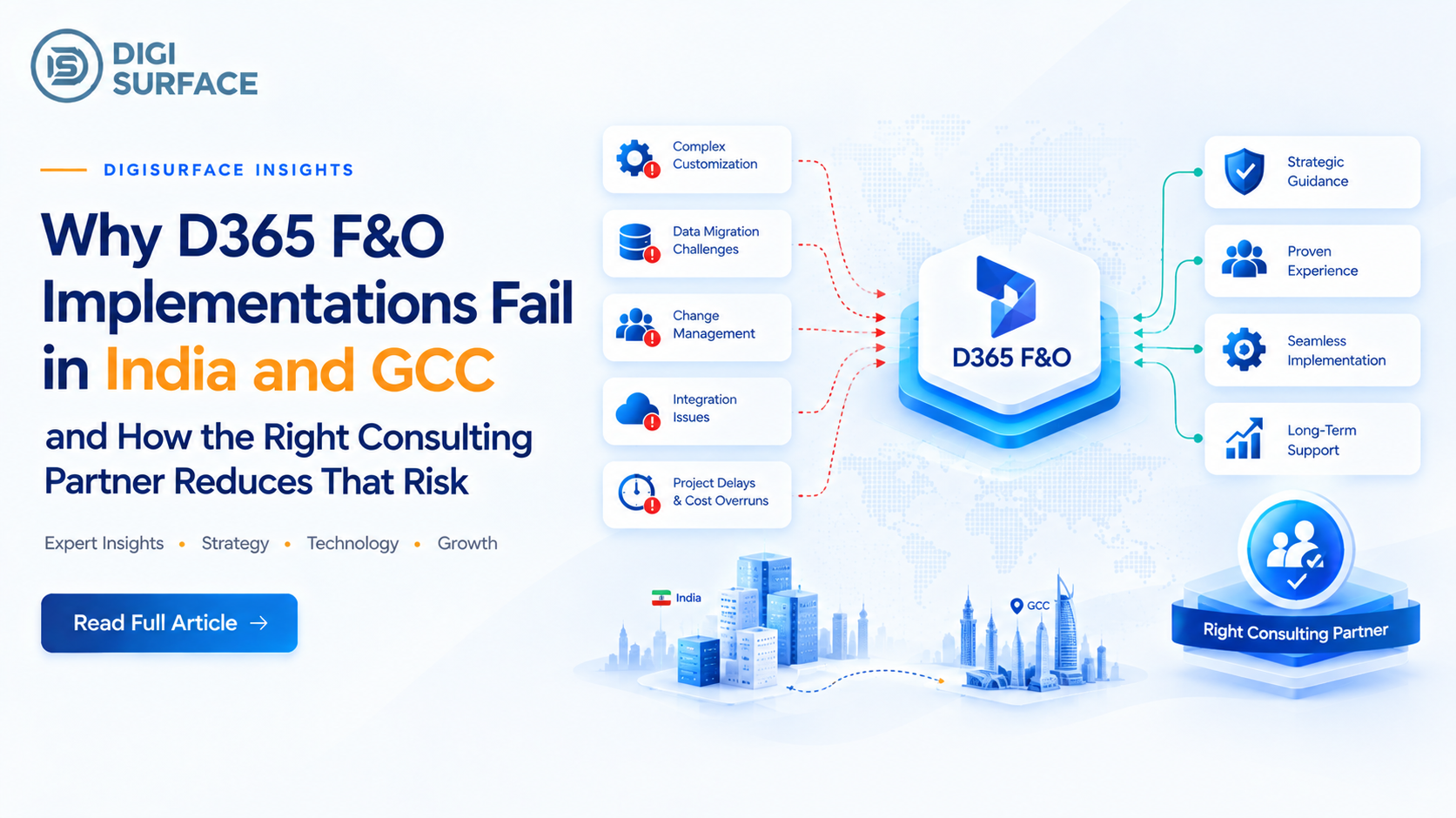
    Most Dynamics 365 Finance & Operations implementations in India and the GCC don’t fail because of the software; they fail because of who was hired to implement it. Gartner projects that by 2027, more than 70% of recently implemented ERP initiatives will fail to fully meet their original business goals. Microsoft has also retired its old Gold and Silver partner tiers in favor of the Solutions Partner for Business Applications designation, introduced when its partner program was overhauled in 2022. Most buyers evaluating a Dynamics 365 F&O consulting company still don’t know to check for it.

    DigiSurface has run multi-country D365 F&O rollouts, including a multi-country deployment for COFCO International, built around the same fit-gap, localization, and vendor-evaluation discipline this article breaks down below.

    Why D365 F&O Implementations Actually Fail

    Gartner projects that more than 70% of recently implemented ERP initiatives will fail to fully meet their original business goals by 2027, according to Gartner research shared via LinkedIn. That number gets treated as a software problem. It usually isn’t. Dynamics 365 Finance & Operations is a proven, widely deployed ERP; what fails is almost always the process around it the partner selected, the rigor of the discovery phase, and how seriously localization gets treated before go-live rather than after.

    D365 F&O itself is a unified ERP covering finance, supply chain, and operations management in a single cloud platform, built for organizations that have outgrown disconnected tools stitched together with manual exports and reconciliation. The software isn’t the risk. The implementation is.

    In India and the GCC specifically, three failure patterns show up more often than any others:

    Fit-gap analysis skipped or rushed. A fit-gap analysis maps your actual “as-is” operations against what D365 F&O handles natively (“fits”) versus what needs custom development (“gaps”). Partners under time or cost pressure sometimes compress or skip this step, basing their quote on a sales call instead of a documented assessment, and the gaps discovered mid-implementation are the ones that blow both budget and timeline.

    Localization treated as an add-on, not a core requirement. India’s PF, ESI, TDS, and GST-linked reporting, and the GCC’s GOSI, WPS, and country-specific VAT rules, aren’t edge cases; they’re core to whether the system actually works for a regional business on day one. Partners without direct localization experience in these frameworks tend to treat them as post-go-live patches.

    No real multi-entity, multi-country track record. A partner who has configured D365 F&O for a single-country, single-currency business hasn’t necessarily solved the harder problem: standardizing processes across multiple entities, currencies, and regulatory environments without forcing every region into an identical template that doesn’t fit local requirements.

    None of these are software limitations. They’re the direct result of who gets hired to run the implementation.

    What a Real D365 Finance & Operations Implementation Involves

    Dynamics 365 Finance and Operations (D365 F&O) is Microsoft’s cloud ERP platform, unifying finance, supply chain, and operations management for mid-to-large enterprises running multi-entity, multi-currency, or multi-country operations that a smaller, single-region system can’t handle.

    A properly run D365 F&O implementation moves through a structured sequence: project governance and scope definition, fit-gap analysis, core module configuration (general ledger, accounts payable/receivable, organizational structure), configuration and testing across development and UAT environments, and a formal go-live readiness review. Each phase deserves its own scrutiny, but the phase most commonly compressed under deadline pressure is the fit-gap step, which is exactly the one that determines whether the rest of the timeline holds.

    (For a full breakdown of how D365 F&O compares to another major ERP platform, see our Dynamics 365 F&O vs SAP S/4HANA comparison.)

    Why Partner Certification Matters Now: The Solutions Partner Shift

    This is the part most buyers evaluating a Dynamics 365 FnO consulting company still don’t know to check.

    In March 2022, Microsoft announced an overhaul of its partner program, effective October 3, 2022: the legacy Gold and Silver competency badges a system that had existed for roughly two decades were retired and replaced with six Solutions Partner designations, one of which is Solutions Partner for Business Applications, covering Dynamics 365 and the Power Platform.

    The change wasn’t cosmetic. Under the old system, a partner earned Gold or Silver status per individual competency, and many partners advertised broad “Gold Partner” status without that necessarily reflecting deep expertise in any one area. Under the new system, eligibility is based on a partner capability score, a composite measure across three categories: Performance, Skilling, and Customer Success calculated from data already tracked in Microsoft’s Partner Center. It’s harder to earn, and it’s specific: a partner can hold a Business Applications designation without necessarily holding Security or Data & AI, which tells you exactly where their actual depth sits.

    Most GCC and India buyers are still asking prospective vendors, “Are you a Gold Partner?” a question the market retired years ago. The right question in 2026 is: “Do you currently hold the Solutions Partner for Business Applications designation?”

    Legacy Model (pre-Oct 2022)Current Model (2026)
    StructureGold/Silver badges per competency, ~18 legacy competencies6 unified Solutions Partner designations
    Relevant designation for D365 F&O“Gold ERP” competencySolutions Partner for Business Applications
    Basis for qualificationCertification volume, historicalPartner capability score: Performance + Skilling + Customer Success
    What it actually signalsA partner achieved a badge at some pointCurrent, measured capability, re-evaluated on an ongoing basis

    The 5-Point D365 FnO Partner Evaluation Framework

    This is the framework DigiSurface uses internally, and the one we’d recommend any business use before signing with any Dynamics 365 FnO consulting company, not just us.

    1. Solutions Partner Certification. Confirm current Solutions Partner for Business Applications status directly, not a legacy Gold/Silver badge still sitting on a website from before 2022.
    2. Fit-Gap Discipline. Ask to see a sample fit-gap deliverable, not just a proposal. A partner who can’t produce one likely doesn’t run a documented process.
    3. Localization Depth. Ask specifically how they handle GST, PF, ESI, and TDS (India) or GOSI, WPS, and VAT (GCC). A generic “we handle compliance” answer is the clearest red flag on this list.
    4. Multi-Entity, Multi-Country Proof. Ask for a named reference where they ran a live multi-entity, multi-currency rollout, not a single-country deployment described in multi-country language.
    5. Post-Go-Live Support Model. Ask what support looks like after go-live, specifically a defined support tier and SLA, not a vague assurance of “ongoing help.”

    How DigiSurface Reduces D365 F&O Implementation Risk

    DigiSurface supported COFCO International’s multi-country Dynamics 365 Finance & Operations rollout across four countries, standardizing business processes and improving operational visibility across regions that had previously run on disconnected local systems a direct example of point 4 above, not a hypothetical one.

    Scored against the framework above, DigiSurface’s approach is built around: documented fit-gap analysis conducted before configuration begins; India localization (GST, PF, ESI, TDS) and GCC localization (GOSI, WPS) configured directly into the implementation rather than layered on afterward, with the same compliance depth covered in our D365 HR & Payroll solution; and proven multi-entity, multi-country rollout experience through the COFCO engagement.

    If your organization is currently evaluating a Dynamics 365 FnO consulting company, run every candidate including us through the five points above before signing.

    Frequently Asked Questions

    What does D365 Finance and Operations actually do?

    D365 F&O is Microsoft’s cloud ERP platform that unifies finance, supply chain, and operations management in one system, replacing disconnected tools with shared, real-time data across an organization. It’s built specifically for mid-to-large businesses with multi-entity or multi-country complexity.

    What’s the difference between D365 Finance and Operations and Business Central?

    D365 F&O is built for larger, more complex, multi-entity organizations with deep customization and multi-country requirements. Business Central targets small to mid-market businesses with simpler operational structures and faster, lower-cost implementations.

    What is the Microsoft Solutions Partner for Business Applications designation?

    It’s one of six Solutions Partner designations Microsoft introduced in October 2022 to replace the legacy Gold/Silver competency system. It specifically certifies a partner’s demonstrated capability across Dynamics 365 and the Power Platform, based on a measured partner capability score rather than a one-time badge.

    Why do D365 F&O implementations fail in India and the GCC specifically?

    The most common causes are a rushed or skipped fit-gap analysis, localization (GST/PF/ESI/TDS or GOSI/WPS) treated as an afterthought rather than built into the implementation plan, and partners without genuine multi-entity, multi-country rollout experience.

    Who are the implementation partners for Dynamics 365?

    The Dynamics 365 partner ecosystem includes global system integrators and regional specialists holding Microsoft’s Solutions Partner for Business Applications designation. When evaluating any partner, confirm their current designation status directly with Microsoft rather than relying on a website badge alone.

    How many modules does D365 F&O have?

    D365 F&O covers core modules including General Ledger, Accounts Payable/Receivable, Fixed Assets, Inventory Management, Procurement, Production Control, and Human Resources, with the exact configuration depending on which capabilities a specific implementation enables.

    Choosing a Partner Is a Risk Decision, Not a Formality

    A 70%-plus ERP failure rate isn’t a reason to avoid D365 F&O it’s a reason to be rigorous about who implements it. Run any Dynamics 365 FnO consulting company you’re evaluating through the five-point framework above. If you want a second opinion on where a current implementation stands, or a fit-gap assessment before you start one, 

    Book a consultation with DigiSurface.