
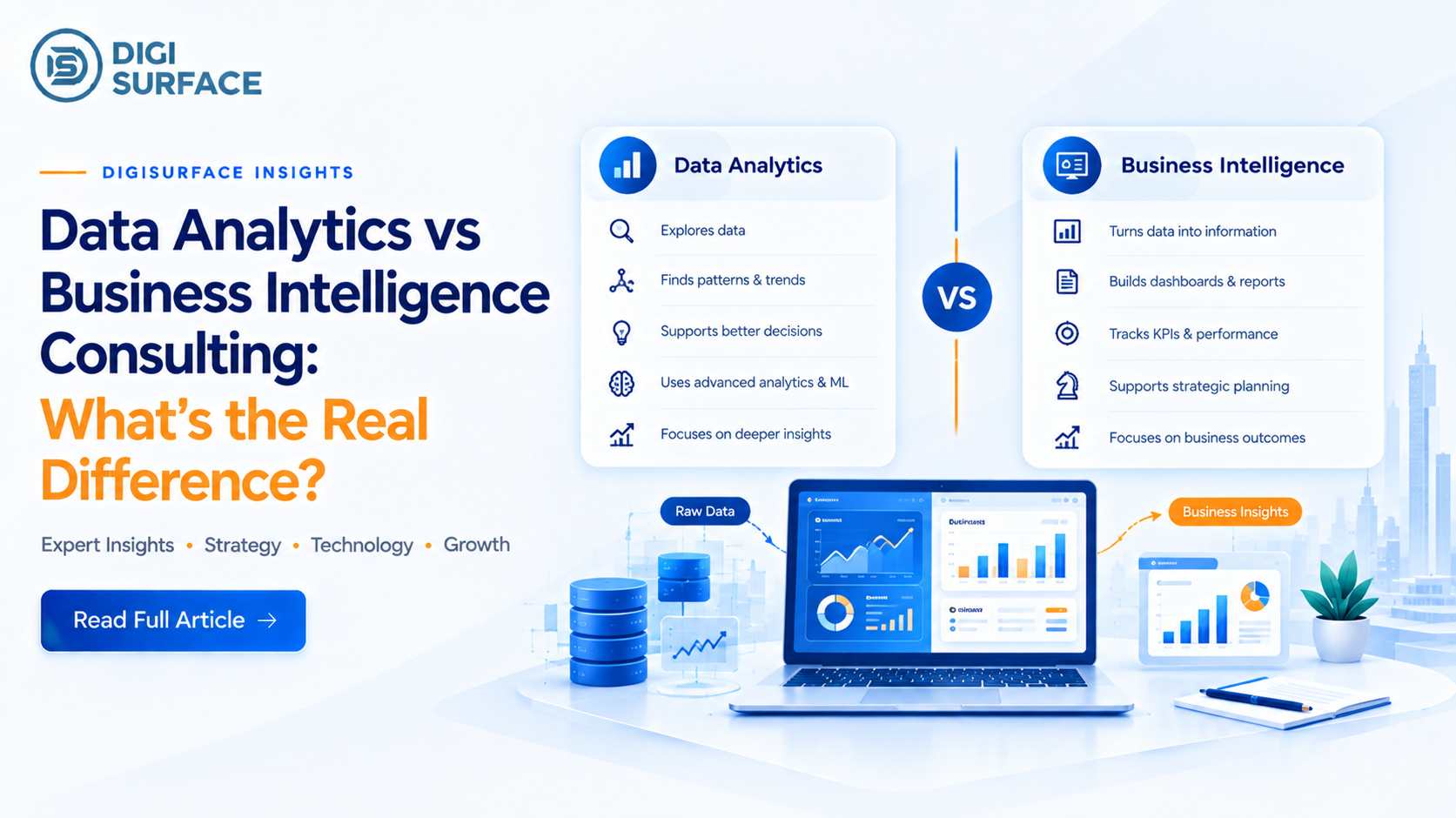
Business intelligence (BI) consulting builds the infrastructure and dashboards that show what’s happening right now data pipelines, warehouses, and reporting. Data analytics consulting goes further, applying statistics and modeling to explain why something happened and forecast what’s likely next. They’re sequential, not competing: BI consulting establishes clean, trustworthy data architecture; data analytics consulting then runs advanced analysis on top of that foundation. The global BI and analytics market is valued at approximately $50.4B in 2026, projected to reach $95.8B by 2033 at a 9.6% CAGR. Professional services rather than software licensing account for the majority of that spend, meaning most buyers are paying for expertise and implementation, not just a tool subscription. Understanding which one you actually need and often, that you need both, in sequence determines whether that spend produces a usable system or an expensive dashboard nobody trusts.
If you’re not sure whether your business needs BI consulting, data analytics consulting, or both use the decision framework in this article to identify exactly where your data maturity sits before you brief a vendor. Book a free data strategy consultation →
1. BI Consulting vs Data Analytics Consulting: The Actual Difference
The confusion is understandable both fields use overlapping tools (Power BI, Tableau, SQL) and both ultimately serve the same goal: better decisions. But they answer fundamentally different questions.
| Business Intelligence (BI) Consulting | Data Analytics Consulting | |
| Core question answered | What is happening (now, and historically)? | Why did it happen, and what happens next? |
| Temporal focus | Historical and real-time | Diagnostic and predictive |
| Primary outputs | Data pipelines, warehouses, dashboards | Statistical models, segmentation, forecasts |
| Typical tools | Power BI, Tableau, SQL, ETL pipelines | Python, R, statistical modeling, machine learning |
| Where it sits in the stack | Foundation: clean, structured, accessible data | Built on top of that foundation |
A simple example: a BI dashboard shows that sales dropped last month. Data analytics is what tells you which customer segment stopped buying, and why and whether that trend is likely to continue next quarter.
2. How They Work Together (Not Instead of Each Other)
This is the part most comparisons get backwards by presenting BI and analytics as a choice. In practice, they’re sequential layers:
- Foundation first- BI consulting sets up the data architecture (pipelines, a warehouse or lake, governance) that analytics work depends on. Skipping this step and jumping straight to predictive modeling on ungoverned, inconsistent data produces models nobody should trust.
- Deeper answers: second, data analytics consulting takes that structured, reliable data and runs the statistical and predictive work that a BI dashboard alone can’t do.
Trying to buy advanced predictive analytics before the underlying data infrastructure is sound is one of the most common reasons a data project fails to deliver not because the analytics were wrong, but because the data feeding them wasn’t trustworthy yet.
3. Which One Does Your Business Actually Need Right Now?
A practical self-check, not a sales pitch:
- You need BI consulting first if: your data lives in disconnected spreadsheets or systems that don’t talk to each other, leadership makes decisions on data that’s days or weeks old, or you don’t yet have a single reliable source of truth for core metrics.
- You’re ready for data analytics consulting if your BI foundation is already solid, data is centralized, dashboards are trusted, but you need to know why a metric moved, or you want to forecast rather than just report.
- Most enterprises need both, in sequence, which is exactly why “data analytics consulting services” as a category increasingly bundles the BI foundation work in with the deeper analytical work, rather than treating them as separate purchases.
4. What’s Actually Included in Data Analytics Consulting Services
Beyond dashboards, a proper data analytics consulting engagement typically spans:
- Data strategy consulting: a roadmap for how data gets collected, stored, and governed across the business, not just a tool selection exercise
- Data governance: access controls, data quality standards, and ownership accountability, so “clean data” doesn’t quietly degrade six months after go-live
- Data warehouse consulting: designing the centralized storage layer (cloud data warehouse or lake) that both BI and analytics work draws from
- Enterprise data management services: the broader discipline of treating data as a managed asset across the organization, not a byproduct of individual departments’ tools
Skipping governance and strategy in favor of jumping straight to dashboards is a common shortcut, and it’s exactly why so many BI implementations degrade into “the numbers don’t match” within a year.
5. The Technical Layer: Azure Data Factory and Enterprise Data Pipelines
For enterprises with data spread across ERP, CRM, and legacy systems, the technical backbone connecting all of it is typically an ETL/data integration layer. Azure Data Factory implementation is one of the more common approaches in Microsoft-ecosystem enterprises, specifically moving data from source systems into a centralized warehouse or lake on a scheduled or triggered basis, so BI and analytics work isn’t dependent on manual exports.
This is the layer most business stakeholders never see directly, but it’s the one that determines whether a dashboard reflects this morning’s numbers or last week’s the difference between BI that’s actually operational and BI that’s a monthly report with extra steps.
6. How DigiSurface Approaches Data Analytics Consulting Services
DigiSurface builds the full stack described above rather than selling either layer in isolation: BI foundation work (pipelines, warehouses, dashboards) and deeper analytics work, sequenced correctly rather than sold as competing options. This includes:
- Data strategy and governance frameworks built for the specific compliance environment (India or GCC) a business operates in
- Azure Data Factory implementation and enterprise data management services connecting ERP, CRM, and legacy systems into a single reliable source
- Power BI dashboard delivery once the underlying data foundation is solid, not before
Proof point: DigiSurface built the enterprise data platform for the Central Bank of Oman on Oracle Cloud Infrastructure data governance and residency-compliant architecture first, analytics and reporting on top of it the same foundation-then-analytics sequence this article describes- applied to one of the more regulated environments a data platform can be built for.
Frequently Asked Questions
What is data analytics consulting and what does it do?
Data analytics consulting is a professional service that helps organizations collect, clean, structure, and analyze their data, typically including data strategy, statistical modeling, and predictive forecasting to support decisions that go beyond simple historical reporting.
Is business intelligence the same as ETL?
No. ETL (Extract, Transform, Load) is one technical process within BI, moving and preparing data from source systems into a warehouse. BI consulting is the broader discipline that includes ETL alongside dashboard design, reporting, and data architecture.
Are business intelligence and business analytics the same?
No. Business intelligence focuses on reporting current and historical performance what’s happening. Business analytics (and data analytics) goes further into diagnostic and predictive analysis: why it happened and what’s likely next. They’re related but distinct disciplines that typically build on each other.
What is a business intelligence consultant?
A BI consultant helps a business design its data strategy, select and implement tools like Power BI or Tableau, build data pipelines and warehouses, and design dashboards that give teams reliable, current visibility into operations.
Which is better, business intelligence or data analytics?
Neither is inherently “better”; they answer different questions. BI tells you what’s happening now; analytics tells you why and what’s next. Most mature organizations need both, with BI providing the data foundation that analytics work depends on.
What are the top business intelligence tools?
The most widely used enterprise BI tools include Microsoft Power BI, Tableau, and Qlik, typically paired with SQL-based data warehouses and ETL pipelines such as Azure Data Factory for enterprises in the Microsoft ecosystem.
The Real Question Isn’t BI vs Analytics; It’s What Order You Need Them In
With professional services making up the bulk of BI and analytics spend rather than software licensing [per Coherent Market Insights’ market report], the actual decision most enterprises are making isn’t which tool to buy; it’s which consulting partner understands the difference between building the data foundation and building on top of it. Get the sequence wrong, and even the best analytics model runs on data nobody trusts.
Book a data strategy consultation with DigiSurface to find out exactly where your organization sits on that path.